




Description
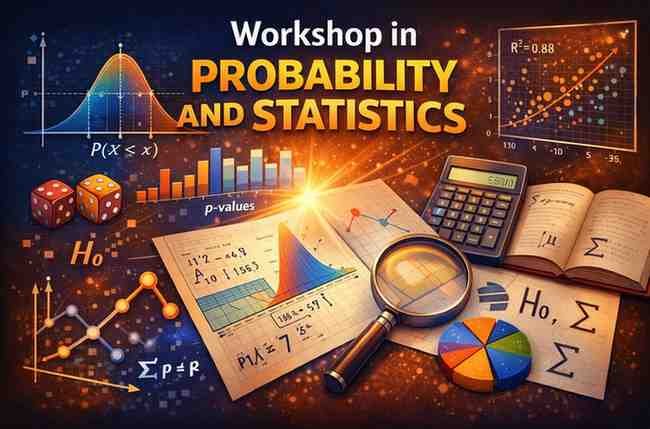
Workshop in Probability and Statistics is a structured, application-oriented course designed to simplify statistical concepts through guided practice and real problem-solving sessions. The course focuses on helping learners understand probability and statistics not just theoretically, but through step-by-step demonstrations and workshop-style learning.
Unlike traditional statistics courses that rely heavily on formulas and abstract explanations, this program emphasizes clarity, intuition, and practical interpretation. It is especially useful for students, analysts, researchers, and professionals who want to confidently apply statistical thinking in academic, business, or data-driven environments.
This review explores the course structure, learning outcomes, teaching quality, strengths, limitations, and overall value for learners.
What You Will Learn
The course builds statistical understanding progressively, ensuring learners develop both conceptual clarity and analytical confidence.
1. Foundations of Probability
The course begins by introducing probability fundamentals in an accessible manner. Instead of overwhelming learners with mathematical notation, concepts are explained using logical reasoning and practical examples.
Key topics include:
-
Basic probability rules
-
Events and sample spaces
-
Conditional probability
-
Independent and dependent events
-
Real-world probability applications
These lessons help learners develop intuition before moving into formal statistical analysis.
2. Descriptive Statistics
A strong emphasis is placed on understanding how to summarize and interpret data effectively.
Topics covered:
-
Measures of central tendency (mean, median, mode)
-
Variability and dispersion
-
Standard deviation and variance
-
Data visualization concepts
-
Understanding distributions
Learners gain the ability to interpret datasets rather than simply calculate metrics.
3. Probability Distributions
The course introduces common statistical distributions and explains when and why they are used.
Coverage includes:
-
Normal distribution concepts
-
Discrete and continuous distributions
-
Expected value
-
Variance interpretation
-
Real-world examples of statistical modeling
The explanations focus on conceptual understanding, making complex ideas easier to absorb.
4. Inferential Statistics and Hypothesis Testing
One of the most valuable sections teaches how conclusions are drawn from data using statistical reasoning.
Key learning areas:
-
Sampling concepts
-
Confidence intervals
-
Hypothesis testing fundamentals
-
Statistical significance
-
Interpreting results correctly
This section helps learners avoid common mistakes in data interpretation and decision-making.
5. Practical Workshop Approach
The defining feature of this course is its workshop methodology. Learners actively follow problem-solving demonstrations that reinforce learning through repetition and application.
You will practice:
-
Solving statistical problems step-by-step
-
Interpreting outputs logically
-
Applying probability concepts to realistic scenarios
-
Building analytical reasoning skills
This hands-on structure makes the course particularly effective for learners who struggle with purely lecture-based teaching.
Teaching Style and Learning Experience
The course adopts a guided learning format that prioritizes understanding over memorization.
Key characteristics of the teaching approach:
-
Clear, incremental explanations
-
Practical examples tied to real situations
-
Problem-solving walkthroughs
-
Reinforcement through repeated application
The pacing allows beginners to keep up while still providing enough depth for learners seeking practical competence.
Practical Applications Covered
The course connects statistical concepts with real-world use cases, including:
-
Data analysis and reporting
-
Academic research interpretation
-
Business decision-making
-
Quality analysis and performance evaluation
-
Foundations for data science and analytics
This practical orientation ensures learners understand how statistics supports real decisions rather than remaining purely academic.
Who This Course Is Best For
Ideal Learners
-
Beginners learning probability and statistics for the first time
-
Students preparing for exams involving statistics
-
Data analysts wanting stronger statistical foundations
-
Business professionals working with reports and data
-
Researchers needing statistical interpretation skills
Not Ideal For
-
Advanced statisticians seeking deep mathematical proofs
-
Learners expecting heavy programming or automation content
-
Those looking only for theoretical academic lectures
Skills You Gain After Completion
After completing the course, learners typically develop:
-
Strong understanding of probability fundamentals
-
Ability to summarize and interpret datasets
-
Confidence in hypothesis testing concepts
-
Improved analytical thinking
-
Practical statistical reasoning skills
These competencies form a solid base for analytics, research, and data-driven roles.
Course Strengths
✅ Workshop-style learning improves retention
✅ Clear explanations suitable for beginners
✅ Strong focus on practical understanding
✅ Logical progression of statistical topics
✅ Useful for academic and professional applications
Areas That Could Be Improved
-
Advanced statistical modeling is limited.
-
More real-world datasets could further enhance practice.
-
Learners seeking programming integration may require supplementary courses.
Career and Learning Value
Probability and statistics are essential skills across multiple industries. This course provides foundational knowledge that supports:
-
Data analytics and reporting roles
-
Business intelligence interpretation
-
Academic research analysis
-
Entry-level data science learning paths
-
Evidence-based decision-making
Because the course emphasizes interpretation and reasoning, learners gain skills directly applicable to real professional scenarios.
Summary
Workshop in Probability and Statistics delivers a clear, practical, and beginner-friendly introduction to statistical thinking. Its workshop-based structure makes complex topics approachable and helps learners build genuine understanding through guided practice.
For anyone looking to strengthen their statistical foundation without being overwhelmed by advanced mathematics, this course offers strong educational value and practical relevance.


Reviews
There are no reviews yet.