




Description
Introduction
Mathematics is a foundational skill that influences success in academics, technology, finance, and everyday problem-solving. However, many students struggle with advanced subjects simply because their basic mathematical concepts were never fully developed. Weak understanding of numbers, fractions, ratios, and arithmetic logic often creates long-term learning barriers.
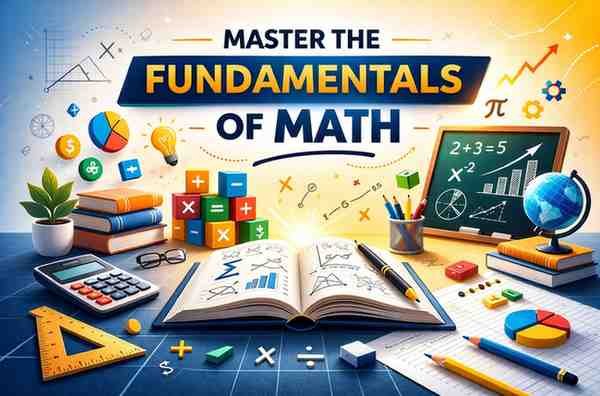
Master the Fundamentals of Math is designed to rebuild mathematical confidence from the ground up. This course focuses on strengthening essential math skills through clear explanations, structured lessons, and extensive practice exercises. In this detailed review, we analyze the course curriculum, teaching style, benefits, limitations, and who will benefit most before enrolling.
What You Will Learn
The curriculum follows a step-by-step progression, ensuring learners build confidence gradually.
1. Understanding Numbers and Core Math Concepts
The course begins with essential numerical foundations, including:
-
Types of numbers and number properties
-
Factors and multiples
-
Prime numbers
-
Divisibility rules
-
Mathematical reasoning basics
These lessons focus on understanding how numbers behave rather than memorizing shortcuts.
2. Fractions, Decimals, and Percentages
A major emphasis is placed on areas where students commonly face difficulty:
-
Simplifying fractions
-
Converting fractions and decimals
-
Operations with mixed numbers
-
Percentage calculations
-
Practical numerical comparisons
Clear demonstrations help learners understand the logic behind calculations.
3. Ratios and Proportions
This section connects mathematics to real-life applications through:
-
Ratio interpretation
-
Proportional reasoning
-
Comparison problems
-
Everyday calculation scenarios
These concepts serve as a bridge toward algebra and analytical thinking.
4. Exponents, Roots, and Basic Mathematical Operations
Learners are introduced to slightly advanced foundational topics such as:
-
Exponent rules
-
Square roots and radicals
-
Order of operations
-
Scientific notation basics
These skills prepare students for algebra and technical subjects.
5. Practice and Skill Reinforcement
The course strongly emphasizes active learning through:
-
Step-by-step solved examples
-
Practice quizzes after lessons
-
Repetition-based reinforcement
-
Guided problem-solving methods
This practice-focused approach helps convert theoretical understanding into practical skill.
Course Structure and Learning Experience
The course is organized into short, focused lessons that prevent cognitive overload. Each concept builds logically on previous topics, allowing learners to progress comfortably even with minimal prior math confidence.
Key structural advantages include:
-
Beginner-friendly progression
-
Clear topic segmentation
-
Self-paced accessibility
-
Continuous skill evaluation through exercises
-
Concept reinforcement through repetition
The pacing makes the course suitable for both students and adult learners returning to mathematics after a long gap.
Teaching Style
The instructor follows a concept-first teaching methodology, emphasizing understanding over memorization.
Instructional Approach
-
Step-by-step explanations
-
Simple language for complex ideas
-
Real-time problem solving
-
Focus on reasoning and logic
-
Common mistake clarification
This approach mirrors guided tutoring rather than fast-paced academic lectures, making learning less intimidating for beginners.
Who This Course Is Best For
This course is ideal for:
✅ Students struggling with math basics
✅ Learners preparing for algebra or higher mathematics
✅ Competitive exam aspirants needing math revision
✅ Adults rebuilding math skills for career growth
✅ Parents or self-learners seeking strong foundational knowledge
It is particularly useful for learners who feel they lack confidence in mathematics.
Skills You Will Gain
After completing the course, learners can expect to:
-
Perform arithmetic calculations accurately
-
Understand number relationships and properties
-
Solve fraction and percentage problems confidently
-
Apply ratios and proportions logically
-
Work with exponents and roots comfortably
-
Build readiness for algebra and advanced math subjects
These skills form the essential base required for academic and professional quantitative work.
Pros and Cons
✅ Pros
-
Excellent for beginners and weak math learners
-
Clear and easy-to-follow explanations
-
Strong focus on conceptual understanding
-
Practice-oriented learning structure
-
Suitable for all age groups
-
Self-paced flexibility
⚠️ Cons
-
Not intended for advanced mathematics learners
-
Requires consistent practice for noticeable improvement
-
Limited coverage of higher-level problem solving
Difficulty Level
Difficulty: Beginner-friendly
The course assumes only very basic arithmetic knowledge. Concepts are introduced gradually, allowing learners to build confidence without feeling overwhelmed.
Career and Academic Benefits
Strong mathematical fundamentals are essential for success in many areas, including:
-
Engineering and science education
-
Data analytics and programming
-
Finance and accounting
-
Competitive examinations
-
Business and logical decision-making
Learners with solid fundamentals typically progress faster when studying algebra, statistics, or calculus later.
Summary
Master the Fundamentals of Math is an excellent foundation-building course for anyone looking to strengthen their core mathematical skills. The structured curriculum, clear teaching style, and extensive practice opportunities make it particularly effective for beginners and learners rebuilding confidence.
Rather than rushing into complex topics, the course focuses on mastery of essentials — a strategy that significantly improves long-term mathematical understanding.


Reviews
There are no reviews yet.