




Description
Introduction
Algebra is one of the most important foundations of mathematics. It supports higher-level subjects such as calculus, statistics, data science, engineering, finance, and computer science. However, many learners struggle with algebra because traditional teaching methods often focus on memorization instead of conceptual understanding.
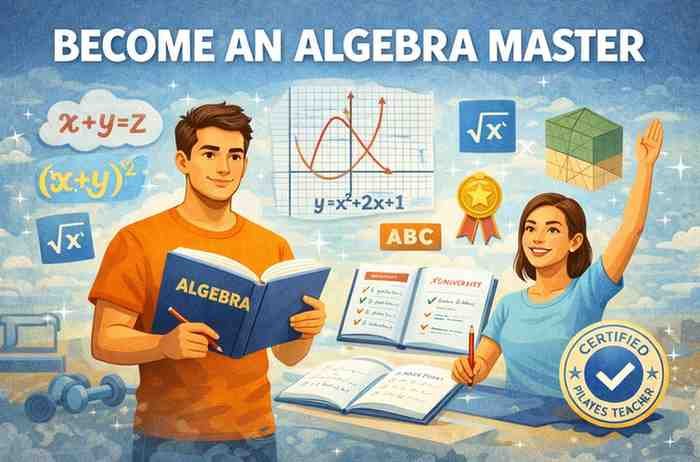
Become an Algebra Master is designed to simplify algebra and help learners build strong mathematical confidence through structured lessons and step-by-step explanations. This review provides a detailed evaluation of the course curriculum, teaching quality, practical usefulness, strengths, and limitations to help you decide whether it is the right learning investment.
Course Overview
This course focuses on helping students understand algebra from the ground up while gradually progressing toward advanced problem-solving techniques. Instead of assuming prior mathematical expertise, it builds concepts systematically, making algebra approachable for beginners and useful as a refresher for experienced learners.
Core Learning Objectives
By completing the course, learners can expect to:
-
Understand algebraic expressions and equations
-
Solve linear and quadratic equations confidently
-
Work with functions and inequalities
-
Master factoring techniques
-
Develop logical mathematical reasoning
-
Strengthen problem-solving skills
The course emphasizes understanding mathematical logic rather than simply applying formulas.
Course Curriculum Breakdown
1. Algebra Fundamentals
The course begins with essential algebra concepts to ensure learners develop a strong base before moving to advanced topics.
Key topics include:
-
Variables and constants
-
Algebraic expressions
-
Order of operations
-
Simplifying expressions
-
Basic equation solving
This section is particularly helpful for learners who previously struggled with mathematics or want to rebuild their fundamentals.
2. Linear Equations and Inequalities
Linear equations form the backbone of algebra. The instructor explains how equations represent relationships between variables and how to solve them step-by-step.
Topics covered:
-
Solving single-variable equations
-
Multi-step equations
-
Word problems using algebra
-
Inequalities and solution sets
-
Graphical interpretation basics
The focus on practical examples improves conceptual clarity.
3. Factoring Techniques
Factoring is often a challenging area for students, but it is essential for advanced mathematics.
Learners explore:
-
Common factor extraction
-
Factoring trinomials
-
Difference of squares
-
Polynomial factorization methods
-
Recognizing factoring patterns
Clear demonstrations help learners understand when and why each technique should be used.
4. Quadratic Equations
Quadratic equations represent a major milestone in algebra learning. This module explains multiple approaches for solving them.
Covered methods include:
-
Factoring method
-
Completing the square
-
Quadratic formula
-
Understanding parabolic behavior
-
Practical equation applications
The structured explanation helps learners build confidence with complex equations.
5. Functions and Graphs
Understanding functions connects algebra with real-world modeling and higher mathematics.
Key lessons include:
-
Function notation
-
Evaluating functions
-
Graph interpretation
-
Domain and range concepts
-
Relationships between equations and graphs
This section prepares learners for calculus and analytical subjects.
6. Advanced Problem Solving
The course concludes with applied algebra problems that strengthen logical reasoning.
Students practice:
-
Multi-step algebra problems
-
Real-world mathematical scenarios
-
Analytical thinking techniques
-
Exam-style problem solving
This module reinforces learning through repetition and practical application.
Teaching Style and Learning Experience
The teaching approach is structured, clear, and beginner-friendly. Concepts are explained progressively, ensuring learners understand each step before advancing.
Learning Experience Highlights
-
Step-by-step problem explanations
-
Clear mathematical reasoning
-
Practice-oriented lessons
-
Logical progression of topics
-
Focus on understanding rather than memorization
The pacing allows learners to build confidence gradually, which is essential for mastering mathematics.
Who Should Take This Course?
This course is ideal for:
✅ Students preparing for higher mathematics
✅ Beginners struggling with algebra fundamentals
✅ Competitive exam learners
✅ Engineering and science students
✅ Data science and analytics beginners
✅ Adults revisiting mathematics after a long gap
It works well both as a primary learning course and as a comprehensive algebra refresher.
Key Benefits
Strong Mathematical Foundation
The course builds algebra knowledge systematically, making future math subjects easier to understand.
Improved Problem-Solving Skills
Algebra strengthens logical thinking, analytical reasoning, and structured problem solving.
Beginner-Friendly Approach
Complex topics are broken down into manageable steps suitable for learners at all levels.
Academic and Career Relevance
Algebra is essential for STEM careers, finance roles, analytics, and technical education paths.
Areas for Improvement
While the course delivers excellent foundational training, some learners may notice:
-
Limited real-world application examples beyond mathematics
-
Minimal integration with technology tools or calculators
-
Advanced algebra topics are introduced but not deeply explored
These limitations are reasonable since the course focuses primarily on mastering core algebra concepts.
Skills You Will Gain
After completing the course, learners typically develop:
-
Confidence solving algebraic equations
-
Strong mathematical reasoning ability
-
Understanding of functions and relationships
-
Improved analytical thinking
-
Preparation for calculus and statistics
-
Enhanced academic performance in mathematics
These skills are transferable across education, technical careers, and analytical professions.
Career and Academic Value
Algebra serves as the gateway to many high-value disciplines. Professionals working in engineering, economics, data science, programming, and finance rely heavily on algebraic thinking.
Mastering algebra helps learners:
-
Interpret quantitative information accurately
-
Solve structured logical problems
-
Prepare for advanced mathematics courses
-
Strengthen analytical decision-making abilities
For students and professionals alike, algebra competence significantly improves learning efficiency in technical subjects.
Summary
If you want to overcome algebra difficulties and build a strong mathematical foundation, Become an Algebra Master provides a clear, structured, and effective learning path. The course focuses on true understanding rather than memorization, making it an excellent choice for students, professionals, and lifelong learners aiming to strengthen their quantitative skills.
Become an Algebra Master is a well-structured and highly effective course for anyone looking to build or strengthen algebra skills. Its clear explanations and logical progression make it especially valuable for beginners and learners who previously found mathematics challenging.

Reviews
There are no reviews yet.