




Description
Introduction
Linear algebra is one of the most important mathematical subjects behind modern technology. From machine learning and artificial intelligence to computer graphics, engineering, and data science, linear algebra forms the mathematical backbone of many high-demand fields. Despite its importance, students often find the subject abstract and difficult due to traditional theory-heavy teaching methods.
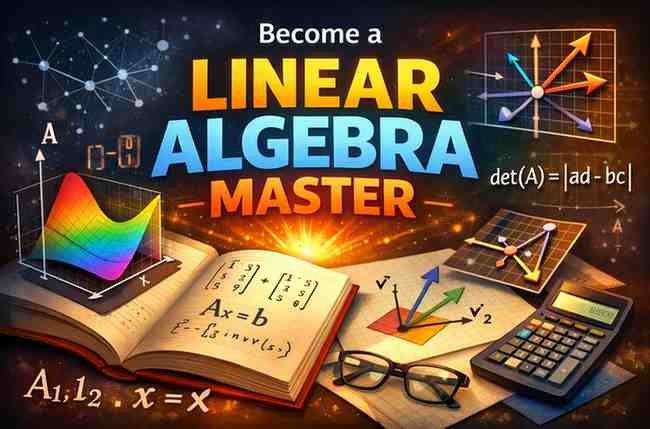
Become a Linear Algebra Master aims to simplify complex concepts through structured explanations and step-by-step problem solving. This detailed course review evaluates the curriculum, teaching approach, learning outcomes, strengths, limitations, and overall value to help learners decide whether this course fits their goals.
What You Will Learn
The course follows a logical progression, starting with foundational concepts and gradually moving toward advanced linear algebra topics.
1. Vectors and Vector Operations
Learners begin with the building blocks of linear algebra:
-
Understanding vectors and vector notation
-
Vector addition and scalar multiplication
-
Magnitude and direction
-
Geometric interpretation of vectors
-
Applications in coordinate systems
This section helps students visualize mathematical relationships instead of treating vectors as abstract symbols.
2. Systems of Linear Equations
A core component of linear algebra involves solving equations efficiently. Topics include:
-
Writing systems of equations in matrix form
-
Gaussian elimination
-
Row operations
-
Reduced row echelon form (RREF)
-
Interpreting solutions geometrically
Students learn systematic approaches used in engineering and computational mathematics.
3. Matrices and Matrix Operations
Matrices are introduced as powerful computational tools:
-
Matrix addition and multiplication
-
Identity and inverse matrices
-
Matrix transformations
-
Determinants and their properties
-
Practical matrix manipulation techniques
Clear examples demonstrate how matrices simplify complex calculations.
4. Vector Spaces and Subspaces
The course gradually transitions into more theoretical concepts while maintaining accessibility:
-
Span and linear independence
-
Basis and dimension
-
Subspaces and column spaces
-
Null space interpretation
These topics build deeper conceptual understanding required for advanced mathematics and machine learning.
5. Eigenvalues and Eigenvectors
One of the most important sections focuses on:
-
Eigenvalues and eigenvectors
-
Characteristic equations
-
Diagonalization
-
Applications in transformations and data analysis
This material is particularly valuable for learners interested in data science, AI, and applied mathematics.
6. Linear Transformations
Students explore how algebra connects with geometry through:
-
Transformation matrices
-
Rotation and scaling transformations
-
Kernel and range concepts
-
Practical interpretation of transformations
This section helps bridge theoretical math with real-world applications.
Course Structure and Learning Experience
The course is organized into manageable lessons that gradually increase in difficulty. Concepts are introduced using intuitive explanations followed by worked examples and practice exercises.
Key structural advantages include:
-
Step-by-step topic progression
-
Concept reinforcement through repetition
-
Practice-driven learning approach
-
Logical transition from basics to advanced ideas
-
Self-paced accessibility for flexible learning
The structured design makes the course suitable even for learners encountering linear algebra for the first time.
Teaching Style
The instructor emphasizes understanding before memorization, which is crucial for mastering linear algebra.
Instructional Characteristics
-
Clear, methodical explanations
-
Visual interpretation of abstract concepts
-
Problem-solving demonstrations
-
Gradual introduction of theory
-
Emphasis on mathematical intuition
Complex topics are broken into smaller steps, making the subject more approachable for beginners.
Who This Course Is Best For
This course is ideal for:
✅ University students studying mathematics, engineering, or computer science
✅ Data science and machine learning beginners
✅ Programmers wanting stronger mathematical foundations
✅ Self-learners preparing for advanced math courses
✅ Anyone struggling with traditional linear algebra classes
It works especially well for learners who prefer structured explanations over purely theoretical lectures.
Skills You Will Gain
After completing the course, learners can expect to:
-
Understand vectors and matrix operations confidently
-
Solve systems of linear equations efficiently
-
Interpret vector spaces and linear independence
-
Compute determinants, eigenvalues, and eigenvectors
-
Understand linear transformations conceptually
-
Build mathematical foundations for machine learning and data analysis
These skills are directly applicable in technical and analytical careers.
Pros and Cons
✅ Pros
-
Comprehensive linear algebra coverage
-
Beginner-friendly explanations
-
Strong balance between theory and problem solving
-
Step-by-step demonstrations
-
Useful for academic and professional learning
-
Self-paced learning flexibility
⚠️ Cons
-
Requires consistent practice to fully grasp concepts
-
Some theoretical sections may feel challenging for absolute beginners
-
Limited real-world coding demonstrations
Difficulty Level
Difficulty: Moderate
While the course starts at a beginner level, linear algebra naturally becomes more abstract as topics advance. Students who actively practice problems alongside lessons will gain the most benefit.
Basic algebra knowledge is recommended before starting.
Career and Academic Benefits
Linear algebra is foundational in many modern disciplines, including:
-
Machine Learning and Artificial Intelligence
-
Data Science and Analytics
-
Computer Graphics and Game Development
-
Engineering and Physics
-
Robotics and Automation
-
Quantitative Finance
Mastering linear algebra significantly improves analytical reasoning and prepares learners for advanced technical subjects.
Summary
Become a Linear Algebra Master provides a structured and comprehensive pathway to understanding one of the most important areas of modern mathematics. The course successfully balances conceptual clarity with practical problem solving, making complex topics accessible without oversimplifying them.
For students, professionals, or self-learners aiming to strengthen mathematical foundations for technology or academic growth, this course offers strong educational value.

Reviews
There are no reviews yet.