




Description
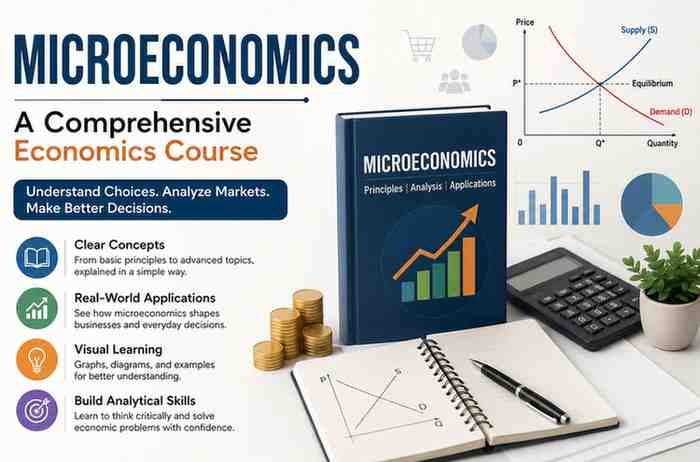
Microeconomics is one of the most important branches of economics because it explains how individuals, businesses, and governments make economic decisions. Understanding microeconomic principles helps people analyze markets, pricing strategies, consumer behavior, and government policies.
The “Microeconomics – A Comprehensive Economics Course” available on Udemy is designed to provide a complete introduction to microeconomic theory and real-world applications. Created by experienced economics educator Brad Cartwright, the course aims to make complex economic ideas easier to understand through practical explanations and engaging lessons.
Course Overview
The Microeconomics – A Comprehensive Economics Course is structured to help students build a strong foundation in microeconomic theory while understanding how economic principles affect real-world markets.
The course explains essential concepts such as demand and supply, market equilibrium, elasticity, government intervention, and market failure. These topics form the core of introductory microeconomics education and are widely taught in universities and economics programs.
With more than 8 hours of on-demand video lessons organized into multiple sections, the course offers a structured learning experience that gradually introduces learners to the fundamental ideas behind economic decision-making.
The course is designed for both students studying economics academically and individuals who want to understand how markets work in everyday life.
What You Will Learn
By completing this course, learners develop a strong understanding of the core principles that shape economic markets.
Key learning outcomes include:
- Understanding the fundamental concepts of microeconomics
- Learning how supply and demand determine prices
- Understanding market equilibrium and price mechanisms
- Learning about elasticity and its impact on consumer and producer behavior
- Understanding government intervention in markets
- Exploring the concept of market failure and externalities
- Developing a deeper understanding of how economics influences public policy and business decisions
These topics help learners understand the economic forces that influence industries, markets, and global economic systems.
Course Curriculum Breakdown
The course is divided into several structured units that guide learners through the essential principles of microeconomics.
Introduction to Microeconomics
The course begins with an introduction to economics and explains how microeconomics studies individual markets and economic decision-making.
Students learn how scarcity, incentives, and economic behavior shape the decisions made by consumers and producers.
Foundations of Economics
This module introduces the fundamental ideas behind economic thinking.
Learners explore concepts such as opportunity cost, marginal decision-making, and how economic systems allocate resources.
Understanding these basic ideas is essential before studying more complex market structures.
Demand, Supply, and Market Equilibrium
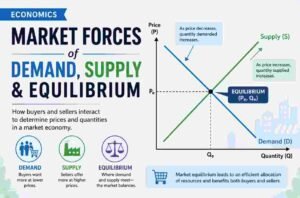
One of the most important sections of the course focuses on the interaction between supply and demand.
Students learn how:
- Demand curves represent consumer behavior
- Supply curves represent producer behavior
- Market equilibrium determines prices and quantities
These concepts explain how markets function in both competitive and real-world economic environments.
Elasticity and Market Response
Elasticity measures how sensitive consumers and producers are to price changes.
In this module, learners explore different types of elasticity, including price elasticity of demand and supply.
Understanding elasticity helps explain why certain products experience large demand changes when prices shift.
Government Intervention in Markets
Governments often intervene in markets to correct economic problems or protect consumers.
This section explains policies such as:
- Indirect taxes
- Price controls
- Subsidies
Students learn how these policies influence market outcomes and economic efficiency.
Market Failure and Externalities
Markets do not always allocate resources efficiently.
This module explains situations where markets fail due to factors such as pollution, public goods, or imperfect information.
Learners explore how governments and institutions attempt to correct these market failures through regulation and policy interventions.
Instructor Background
The course is taught by Brad Cartwright, an experienced educator, international speaker, and economics instructor with many years of teaching experience.
He is known for making economic concepts accessible and engaging by connecting theory with real-world examples and global economic issues.
His teaching approach focuses on simplifying complex ideas so that students from different academic backgrounds can easily understand them.
Who Should Take This Course
The course is suitable for a wide range of learners, including:
- University students studying economics
- IB, AP, or A-Level economics students
- Business and finance professionals
- Entrepreneurs interested in market analysis
- Anyone curious about how economic systems work
Because the course starts with fundamental principles, it is accessible even for learners with no prior knowledge of economics.
Skills You Will Gain
After completing the course, learners will develop practical analytical skills that can be applied in many industries.
These include:
- Economic reasoning and analysis
- Understanding market behavior
- Evaluating supply and demand dynamics
- Analyzing government economic policies
- Interpreting economic trends and decisions
These skills are valuable in fields such as finance, consulting, business strategy, policy analysis, and entrepreneurship.
Course Advantages
Several factors make this course appealing to learners interested in economics.
Clear explanations: Complex economic theories are explained in a simple and engaging way.
Structured learning: The course follows a logical sequence from basic concepts to advanced topics.
Real-world examples: Lessons connect economic theory to real global issues and policies.
Flexible learning: Students can study at their own pace with on-demand video lectures.
Possible Limitations
While the course provides strong foundational knowledge, it primarily focuses on introductory microeconomics.
Learners seeking highly advanced mathematical economic models or research-level analysis may need additional academic courses.
However, for beginners and intermediate learners, the course provides a comprehensive introduction.
Is This Course Worth Taking?
Yes. The Microeconomics – A Comprehensive Economics Course is an excellent starting point for anyone interested in understanding how markets and economic decisions work.
Whether you are a student preparing for economics exams, a professional interested in business strategy, or simply someone curious about how economic systems operate, this course provides a clear and structured introduction to microeconomic principles.
By combining academic theory with real-world applications, the course helps learners build a deeper understanding of how economics shapes markets, policies, and everyday decisions.


Reviews
There are no reviews yet.