


Description
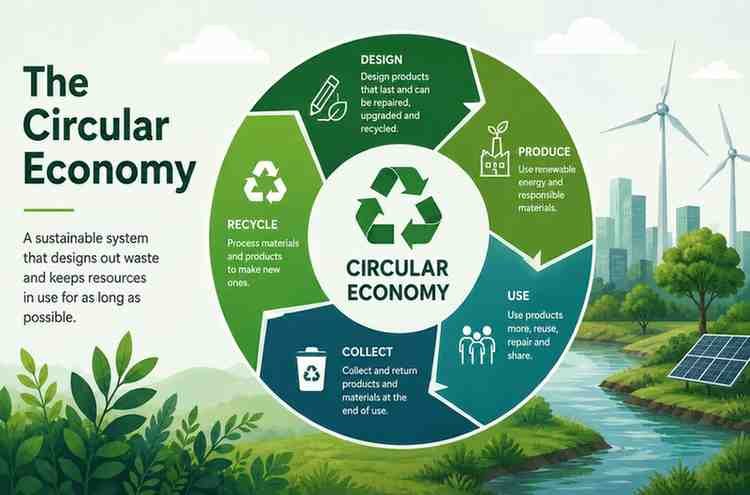
The global economy is increasingly shifting toward sustainability, resource efficiency, and environmentally responsible production. The “The Circular Economy” course on Udemy introduces learners to the concept of circular economic systems and explains how businesses, governments, and individuals can transition from the traditional linear “take-make-dispose” model to a regenerative economic approach.
What You Will Learn
This course focuses on the economic, environmental, and strategic aspects of circular systems. By completing the program, learners gain the knowledge needed to understand and implement circular economy practices.
Understanding the Circular Economy Concept
The course begins by explaining the core concept of the circular economy, which focuses on minimizing waste and maximizing the value of resources. Instead of discarding products after use, materials are reused, repaired, recycled, or regenerated within the economic system.
Key concepts covered include:
- Linear vs circular economic systems
- Resource efficiency and waste reduction
- Regenerative economic models
- Sustainable consumption and production
These concepts form the foundation for understanding how circular economic systems operate.
Circular Business Models
One of the most valuable aspects of the course is its focus on innovative business models within a circular economy.
Students explore several sustainable strategies such as:
- Product-as-a-service models
- Sharing economy platforms
- Product life extension strategies
- Remanufacturing and recycling systems
These approaches enable companies to reduce environmental impact while generating new revenue opportunities.
Sustainable Product Design and Innovation
Another important section focuses on circular design principles, which encourage the development of products that reduce environmental impact throughout their lifecycle.
Topics include:
- Designing products for reuse and repair
- Efficient use of materials
- Sustainable packaging solutions
- Waste reduction during manufacturing
Circular product design allows organizations to build products that last longer and create fewer environmental challenges.
Circular Supply Chain Management
Supply chains play a major role in implementing circular economy strategies. The course explains how organizations can redesign supply chains to support sustainable operations.
Key concepts include:
- Reverse logistics systems
- Recycling and resource recovery
- Responsible sourcing of raw materials
- Supply chain transparency and sustainability
These strategies help create closed-loop systems where resources continuously circulate instead of becoming waste.
Measuring Circular Economy Performance
Organizations must measure their sustainability progress in order to improve their circular initiatives. The course introduces methods used to evaluate environmental and economic impact.
Students learn about:
- Sustainability performance indicators
- Environmental impact measurement
- Resource productivity metrics
- Data-driven sustainability decision-making
These tools help organizations track progress and refine their circular economy strategies.
Course Structure
The course is organized into structured modules that gradually build knowledge about circular economic systems.
Main sections include:
- Introduction to the circular economy
- Differences between linear and circular models
- Circular business models and innovation
- Sustainable product design strategies
- Circular supply chain management
- Measuring sustainability performance
Each section is designed to simplify complex sustainability concepts through practical explanations and examples.
Who Should Take This Course?
This course is suitable for learners who want to understand sustainability and modern economic transformation.
Recommended for:
- Students studying economics or sustainability
- Entrepreneurs developing eco-friendly businesses
- Corporate managers exploring sustainable strategies
- Environmental policy professionals
- Individuals interested in sustainable development
It is particularly useful for those who want to learn how sustainability can be integrated into modern business practices.
Key Advantages of the Course
Strong Foundation in Circular Economy Principles
The course clearly explains the transition from traditional economic systems to sustainable circular models.
Practical Business Applications
Learners gain insights into how companies can adopt circular strategies to improve efficiency and reduce waste.
Industry-Relevant Knowledge
Circular economy concepts are increasingly important in manufacturing, supply chain management, and environmental policy.
Beginner-Friendly Learning Approach
The course presents sustainability concepts in a structured and easy-to-understand format.
Potential Limitations
While the course provides valuable insights into circular economic systems, there are some limitations:
- Advanced sustainability analytics are not deeply covered
- Quantitative environmental modeling is limited
- Some learners may want more industry-specific case studies
Despite these minor limitations, the course remains an excellent introduction to circular economy principles.
Skills You Will Gain
After completing the course, learners will be able to:
- Understand circular economy frameworks
- Evaluate sustainable business models
- Analyze resource efficiency strategies
- Design environmentally responsible products
- Implement circular practices in organizations
These skills are increasingly important for professionals working in sustainability, green innovation, environmental management, and responsible business practices.
Final Verdict
The “The Circular Economy” course provides a clear and practical introduction to one of the most important economic transformations of the modern era. As businesses and governments focus more on sustainability and resource efficiency, understanding circular economy principles is becoming increasingly valuable.