



Description
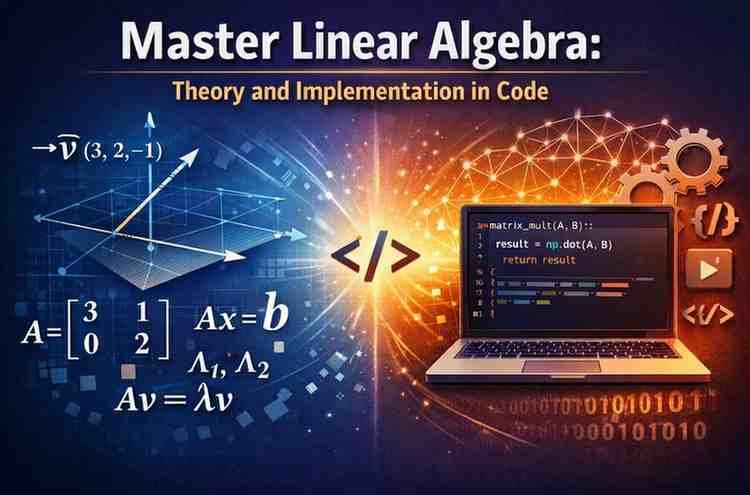
Master Linear Algebra: Theory and Implementation in Code is a practical and concept-focused online course designed to help learners deeply understand linear algebra while simultaneously applying mathematical concepts through programming. Unlike traditional math courses that remain heavily theoretical, this program bridges the gap between abstract mathematical ideas and real-world computational implementation.
The course is structured for students, developers, data analysts, and aspiring machine learning practitioners who want both conceptual clarity and hands-on coding experience in linear algebra.
This review provides a complete breakdown of course content, teaching quality, practical value, strengths, limitations, and who should enroll.
What This Course Teaches
The course covers linear algebra from foundational principles to applied computational techniques. Instead of memorizing formulas, learners understand why mathematical operations work and how they are implemented in code.
1. Foundations of Linear Algebra
The course begins with essential mathematical intuition, ensuring learners build a strong base before moving into advanced material.
Key topics include:
-
Scalars, vectors, and vector spaces
-
Matrix notation and operations
-
Linear combinations and span
-
Systems of linear equations
Concepts are explained visually and logically, making abstract topics easier to grasp.
2. Matrix Operations and Computation
A significant portion of the course focuses on understanding matrices as computational tools.
You will learn:
-
Matrix multiplication and properties
-
Matrix inverses and determinants
-
Rank and linear independence
-
Gaussian elimination methods
Coding demonstrations help learners see how mathematical operations translate into algorithms.
3. Linear Transformations and Geometry
This section connects algebra with geometric interpretation.
Topics include:
-
Transformations in 2D and 3D space
-
Rotation, scaling, and projection
-
Basis and coordinate systems
-
Visualization of transformations
These lessons are particularly valuable for graphics programming, simulations, and machine learning intuition.
4. Eigenvalues and Eigenvectors
One of the most important areas of linear algebra is explained step-by-step.
Coverage includes:
-
Eigen decomposition
-
Characteristic equations
-
Diagonalization
-
Practical interpretation in real systems
The course explains how eigen concepts power modern technologies like recommendation systems and dimensionality reduction.
5. Implementation in Code
What differentiates this course from many academic alternatives is its implementation-focused approach.
Learners practice:
-
Writing matrix operations programmatically
-
Implementing algorithms from scratch
-
Understanding numerical computation challenges
-
Applying linear algebra in data-oriented workflows
This practical integration helps transform theoretical knowledge into usable technical skills.
Teaching Style and Learning Experience
The instructor adopts a structured, progressive teaching method:
-
Concepts introduced intuitively first
-
Mathematical definitions explained clearly
-
Visual demonstrations reinforce understanding
-
Coding exercises solidify learning
Lessons are concise and logically sequenced, reducing cognitive overload often associated with mathematics courses.
The pacing works well for self-paced learners, allowing time to practice between modules.
Practical Applications Covered
The course consistently connects linear algebra to real-world domains, including:
-
Machine learning foundations
-
Data science computations
-
Computer graphics transformations
-
Optimization problems
-
Scientific computing
This applied perspective makes the material highly relevant for modern technical careers.
Who This Course Is Best For
Ideal Learners
-
Data analysts and Power BI professionals wanting deeper math foundations
-
Aspiring machine learning engineers
-
Software developers working with numerical computing
-
Students preparing for AI, data science, or analytics roles
-
Anyone who previously struggled with purely theoretical math courses
Not Ideal For
-
Learners looking for extremely advanced academic proofs
-
Those unwilling to engage with coding exercises
-
Students seeking only quick formula memorization
Skills You Gain After Completion
By the end of the course, learners typically develop:
-
Strong intuition for vector and matrix operations
-
Ability to implement linear algebra algorithms in code
-
Understanding of eigenvalues and transformations
-
Mathematical confidence for machine learning topics
-
Practical computational thinking
These skills form a critical foundation for advanced AI, analytics, and engineering learning paths.
Course Strengths
✅ Excellent balance between theory and implementation
✅ Clear explanations of complex mathematical ideas
✅ Practical coding integration improves retention
✅ Logical progression from basics to advanced topics
✅ Strong relevance to data science and machine learning
Areas That Could Be Improved
-
Some learners may want additional advanced problem sets.
-
Mathematical proofs are simplified rather than deeply formal.
-
Beginners without any math background may need extra practice time.
Career and Learning Value
Linear algebra is one of the most important mathematical pillars behind modern technology. This course provides a career-relevant understanding that supports:
-
Machine learning and AI learning paths
-
Data analytics and modeling
-
Computer graphics and simulations
-
Algorithm design and optimization
Because the course emphasizes implementation, learners gain skills that translate directly into technical projects and portfolios.
Summary
Master Linear Algebra: Theory and Implementation in Code is a highly practical and well-structured course that successfully transforms abstract mathematics into applied technical knowledge. By combining conceptual explanations with coding implementation, it delivers a learning experience that is both intellectually rigorous and professionally useful.
For learners who want to truly understand linear algebra rather than memorize formulas, this course provides strong long-term value and serves as an excellent foundation for advanced data science and machine learning studies.