




Description
Artificial intelligence is rapidly shifting from simple chat-based systems to agentic AI—intelligent systems that can reason, plan, act, and collaborate with tools and other agents. Modern AI engineering roles now demand far more than prompt writing; they require structured agent design, orchestration, and real-world system thinking.
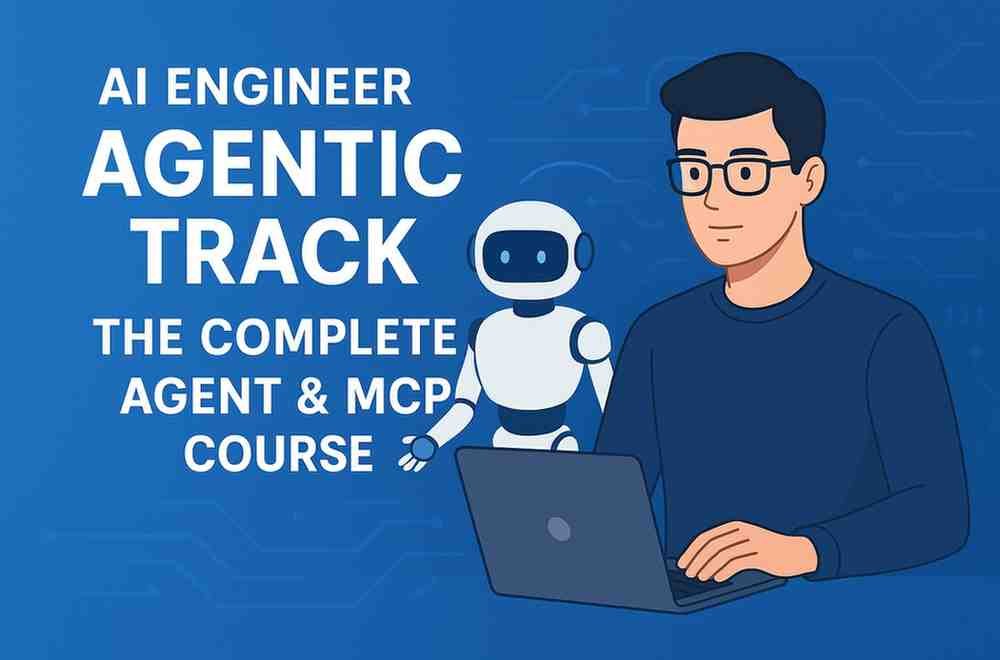
AI Engineer Agentic Track: The Complete Agent & MCP Course is designed to meet this demand. The course focuses on building agent-based AI systems using modern frameworks, multi-agent collaboration, and Model Context Protocols (MCP), preparing learners for next-generation AI engineering roles.
This comprehensive review explains what the course delivers, who it is for, and whether it genuinely helps you transition into agentic AI development.
Course Overview
This course is built around the idea that AI engineers must think like system architects, not just model users. Instead of isolated prompt experiments, the curriculum teaches how to design intelligent agents that can autonomously operate, coordinate, and integrate with external tools and data sources.
The course emphasizes:
-
Agent-based AI architecture
-
Structured workflows and planning
-
Tool-informed decision-making
-
Multi-agent systems
-
Model Context Protocol (MCP) fundamentals
The learning path prioritizes real engineering outcomes rather than theoretical discussions or shallow demos.
What You Will Learn in This Course
1. Foundations of Agentic AI Engineering
The course starts by reframing how learners think about AI.
You will learn:
-
What agentic AI is and how it differs from chatbots
-
Core principles of AI agents and autonomy
-
Components of agent-based systems
-
Real-world use cases for agents
This section builds conceptual clarity before moving into implementation.
2. Designing AI Agents from the Ground Up
Instead of prebuilt abstractions, the course teaches how to architect agents intentionally.
Topics include:
-
Agent goals, roles, and responsibilities
-
Planning and reasoning loops
-
Decision-making strategies
-
Execution control and termination logic
-
Error handling within agents
This helps learners design agents that behave predictably and reliably.
3. Tool-Using and Action-Oriented Agents
A critical strength of the course is its strong focus on tool-aware agents.
You’ll learn how to:
-
Connect agents to APIs and external services
-
Use tools as part of agent reasoning
-
Evaluate tool outputs dynamically
-
Combine LLM intelligence with deterministic logic
This transforms agents from conversational systems into functional problem-solvers.
4. Model Context Protocol (MCP)
The course introduces and explores Model Context Protocol (MCP), an emerging standard for managing context across AI systems.
Key concepts covered:
-
Purpose and importance of MCP
-
Structured context sharing
-
Scaling agent capabilities via contextual design
-
Avoiding prompt overload
-
Designing context-aware agent workflows
This module gives learners an edge in building scalable and maintainable AI systems.
5. Multi-Agent Collaboration Systems
The course goes beyond single-agent design to explore collaborative agent systems.
You will learn:
-
Designing multiple agents with specialized roles
-
Agent-to-agent communication
-
Task delegation and coordination
-
Managing shared state and memory
-
Resolving conflicts between agents
These patterns reflect how advanced AI systems are built in production environments.
6. Memory, State & Long-Running Agents
Real AI agents must maintain continuity.
The course explains:
-
Short-term vs long-term memory
-
Managing persistent agent state
-
Context retention across sessions
-
Improving consistency over long interactions
This is especially valuable for building assistants, operations agents, and automation systems.
7. Real-World Agentic AI Projects
Hands-on implementation is a major strength of the course.
Projects focus on:
-
End-to-end agent workflows
-
Tool-integrated AI applications
-
Multi-agent orchestration
-
Realistic production constraints
These projects serve as portfolio-ready artifacts for AI engineering roles.
8. Best Practices for Agentic AI Engineering
The course also covers lessons learned from real-world deployments.
You’ll learn:
-
Designing maintainable agent architectures
-
Reducing hallucinations and failure loops
-
Cost and performance optimization
-
Debugging complex agent behavior
-
Responsible and safe agent design
This section distinguishes practical engineers from experimenters.
Teaching Style & Learning Experience
The instructional style is:
-
Engineering-focused and pragmatic
-
Structured and progressive
-
Light on hype, heavy on implementation
-
Aligned with real industry expectations
The course assumes learners want to build systems, not just understand concepts.
Pros and Cons
✅ Pros
-
Deep focus on agentic AI engineering
-
Strong coverage of MCP and modern AI design
-
Practical, system-oriented approach
-
Includes multi-agent collaboration patterns
-
Job-relevant and future-focused curriculum
-
Project-based learning
❌ Cons
-
Not suitable for beginners in Python or AI
-
Requires familiarity with LLM concepts
-
Fast-evolving AI landscape may require continuous learning
-
Minimal focus on frontend/UI development
Who Should Take This Course?
This course is ideal for:
-
AI engineers and ML engineers
-
Python developers moving into AI systems
-
Developers building AI agents or copilots
-
Professionals aiming for future AI engineering roles
-
Startups building intelligent automation
Who Should Avoid This Course?
This course may not be ideal if:
-
You are new to programming
-
You only want basic prompt engineering
-
You prefer high-level AI theory over system design
-
You are looking for no-code AI tools
Skills You Will Gain After Completion
Upon completion, learners will be able to:
-
Design and implement agentic AI systems
-
Build tool-integrated AI agents
-
Create scalable multi-agent workflows
-
Apply MCP concepts for context management
-
Architect production-ready AI solutions
These skills align directly with modern AI engineer job requirements.
Is the AI Engineer Agentic Track Worth It?
If your goal is to move beyond simple LLM usage and start building intelligent, autonomous, and scalable AI agents, this course offers significant value. Its focus on agent architecture, MCP, and multi-agent systems makes it particularly relevant for future-facing AI roles.
This course is about engineering AI systems that work, not chasing trends.
Summary
AI Engineer Agentic Track: The Complete Agent & MCP Course is a well-structured, forward-looking program designed for serious AI practitioners. It provides the architectural thinking and hands-on skills required to build the next generation of agentic AI applications.
For developers who want to future-proof their AI careers, this course represents a strong and practical learning investment.


Reviews
There are no reviews yet.