




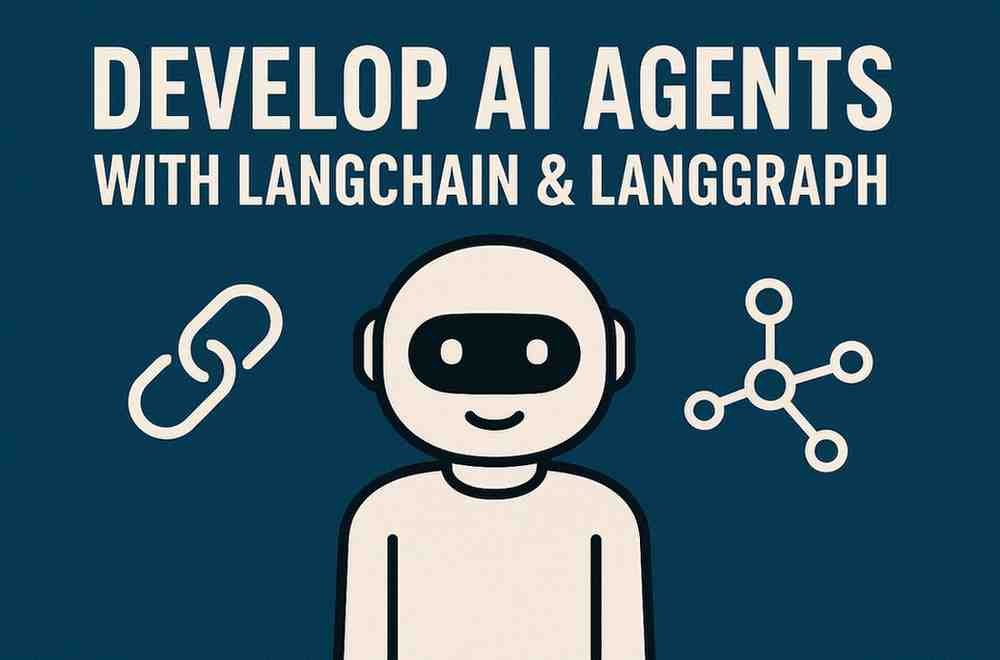
Description
As generative AI evolves, simple prompt-based applications are quickly giving way to autonomous AI agents capable of reasoning, decision-making, and multi-step execution. Frameworks like LangChain and LangGraph have emerged as essential tools for developers building intelligent, production-ready AI systems.
LangChain: Develop AI Agents with LangChain & LangGraph is a Udemy course designed to help developers move beyond basic LLM usage and start building sophisticated AI agents that can interact with tools, maintain memory, and execute complex workflows.
In this detailed review, we’ll examine what the course teaches, how practical it is, who should enroll, and whether it delivers real value for modern AI developers.
Course Overview
This course focuses on agent-based AI application development using LangChain and LangGraph. Instead of limiting learners to prompt engineering, it introduces structured approaches for orchestrating large language models into robust systems.
The learning flow emphasizes:
-
Designing modular AI systems
-
Building agents that think across steps
-
Connecting LLMs with tools and external APIs
-
Managing state, memory, and control flows
-
Creating scalable, maintainable AI workflows
The course is hands-on and code-focused, making it especially relevant for developers and engineers.
What You’ll Learn in This Course
1. Foundations of LangChain
The course begins by establishing a solid understanding of LangChain fundamentals.
You’ll learn:
-
Core LangChain concepts and components
-
Prompt templates and LLM chains
-
Using chains to structure LLM behavior
-
Managing inputs and outputs effectively
-
Organizing reusable AI modules
This foundation helps learners move from simple prompts to structured AI logic.
2. Building AI Agents with LangChain
A core focus of the course is building autonomous AI agents.
Key topics include:
-
Agent architecture and design principles
-
Tool integration for expanded capabilities
-
Decision-making across multiple steps
-
Managing agent execution flow
-
Debugging agent behavior
Learners see how agents can plan actions rather than respond only once.
3. Memory & Context Management
Maintaining conversation and state is critical for intelligent agents.
The course covers:
-
Short-term and long-term memory strategies
-
Storing and retrieving context
-
Maintaining conversation history
-
Enhancing responses using historical knowledge
-
Preventing context overload
This enables agents to behave consistently over extended interactions.
4. Tool Integration & External Systems
The real power of AI agents comes from their ability to interact with tools.
You’ll learn:
-
Connecting agents to external APIs
-
Using tools for data fetching and processing
-
Handling tool outputs securely
-
Orchestrating LLM responses with dynamic tools
This transforms static AI chatbots into functional digital assistants.
5. LangGraph for Agent Workflows
LangGraph introduces structured control over agent execution.
Topics include:
-
Defining nodes, edges, and states
-
Managing complex decision trees
-
Creating multi-agent workflows
-
Controlling execution loops
-
Designing recoverable agent flows
This section is especially valuable for building reliable and production-grade systems.
6. Multi-Agent Systems
Beyond single-agent applications, the course explores collaborative agent systems.
You’ll learn:
-
Designing agent roles and responsibilities
-
Coordinating tasks between agents
-
Managing state across agents
-
Handling conflicts and dependencies
This mirrors real-world AI systems used in automation and enterprise environments.
7. Debugging, Optimization & Best Practices
AI agents can behave unpredictably if not carefully managed.
The course addresses:
-
Debugging AI workflows
-
Improving prompt and chain reliability
-
Reducing hallucinations
-
Optimizing execution costs
-
Designing maintainable AI systems
These lessons are crucial for real-world production use.
8. Real-World AI Agent Projects
The course includes hands-on projects demonstrating real use cases.
Projects focus on:
-
End-to-end AI agent workflows
-
Tool-aware assistants
-
Stateful conversational agents
-
Workflow automation using LLMs
These projects can be used as portfolio examples in AI engineering roles.
Teaching Style & Learning Experience
The instructor’s teaching style is:
-
Practical and code-driven
-
Focused on architecture rather than theory
-
Structured and progressive
-
Oriented toward real-world AI systems
Concepts are explained clearly, followed immediately by implementation and experimentation.
Pros and Cons
✅ Pros
-
Strong focus on AI agent architecture
-
Hands-on LangChain and LangGraph usage
-
Covers both single-agent and multi-agent systems
-
Emphasis on memory and workflow control
-
Suitable for production-oriented AI development
-
Highly relevant to modern AI engineering roles
❌ Cons
-
Not ideal for absolute beginners
-
Requires familiarity with Python and LLM concepts
-
AI ecosystem changes rapidly, requiring ongoing learning
-
Frontend/UI topics are minimal
Who Should Take This Course?
This course is ideal for:
-
AI engineers and developers
-
Python developers moving into LLM applications
-
ML engineers interested in AI systems
-
Developers building intelligent automation
-
Professionals exploring agent-based AI workflows
Who Should Avoid This Course?
You may want to skip or postpone this course if:
-
You are new to Python
-
You want basic prompt engineering only
-
You prefer non-technical AI overviews
-
You are not interested in system architecture
Skills You’ll Gain After Completion
After completing this course, learners can:
-
Build modular AI agents using LangChain
-
Design controlled workflows with LangGraph
-
Integrate AI agents with external tools
-
Manage state, memory, and execution flow
-
Develop scalable AI applications
These skills are critical in modern AI product development environments.
Is LangChain: Develop AI Agents with LangChain & LangGraph Worth It?
If your goal is to build real, intelligent AI agents rather than simple chatbots, this course offers significant value. It focuses on system design, reliability, and real-world use cases—key requirements in professional AI development.
This course is not about hype; it’s about building systems that work.
Summary
LangChain: Develop AI Agents with LangChain & LangGraph is a strong, practical course for developers serious about agent-based AI systems. Its focus on architecture, workflows, and real-world projects makes it a valuable learning investment for modern AI engineering roles.


Reviews
There are no reviews yet.