




Description
Introduction
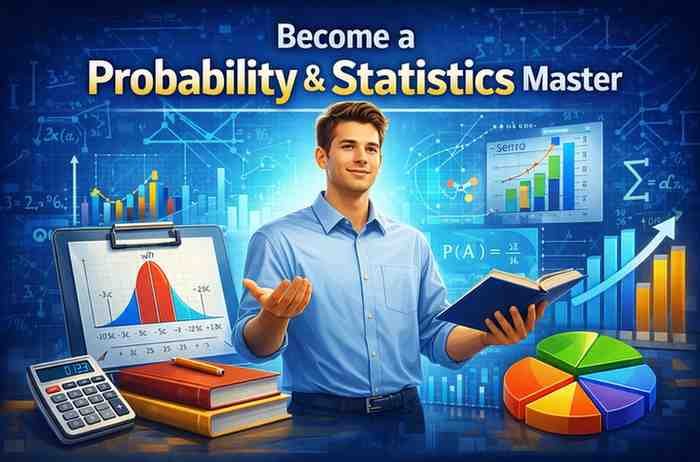
Probability and statistics form the mathematical backbone of modern data-driven industries. From data science and artificial intelligence to finance, business analytics, and research, statistical thinking is no longer optional — it is a core professional skill. Become a Probability & Statistics Master is designed to help learners build strong conceptual and practical foundations in statistics without requiring advanced mathematical background.
This in-depth review evaluates the course from a professional course-review perspective, analyzing its curriculum quality, teaching effectiveness, practical applications, strengths, limitations, and overall value for learners
Course Overview
The course aims to transform beginners into confident users of probability and statistical methods through structured explanations and practical examples. Instead of presenting formulas without context, the program focuses on helping learners understand why statistical concepts work and how they apply to real-world problems.
Key Learning Goals
By completing the course, learners can expect to:
-
Understand core probability concepts and rules
-
Interpret statistical data correctly
-
Apply descriptive and inferential statistics
-
Perform hypothesis testing
-
Understand distributions and sampling techniques
-
Build mathematical intuition for analytics and data science
The course progresses from basic principles to more advanced statistical reasoning, making it suitable for structured self-paced learning.
Course Curriculum Breakdown
1. Foundations of Probability
The course begins with probability fundamentals, ensuring learners develop conceptual clarity before moving into statistics.
Topics typically include:
-
Random experiments and outcomes
-
Probability rules and calculations
-
Conditional probability
-
Independent and dependent events
-
Real-world probability examples
The explanations are designed to reduce mathematical intimidation, making complex ideas accessible to beginners.
2. Descriptive Statistics
This section focuses on understanding and summarizing data — an essential skill for analysts and researchers.
Key concepts covered:
-
Mean, median, and mode
-
Variance and standard deviation
-
Data distribution interpretation
-
Measures of spread and central tendency
-
Visualizing datasets
Learners gain the ability to interpret datasets meaningfully rather than just calculate numbers.
3. Probability Distributions
Probability distributions are critical for understanding uncertainty and prediction. The course explains both theory and application.
Main topics include:
-
Normal distribution
-
Binomial distribution
-
Expected value
-
Probability density concepts
-
Real-world modeling scenarios
This module is particularly valuable for students preparing for data science or machine learning studies.
4. Inferential Statistics
Inferential statistics allows conclusions about populations using sample data — one of the most powerful applications of statistics.
The course introduces:
-
Sampling techniques
-
Confidence intervals
-
Estimation methods
-
Statistical reasoning
-
Decision-making using data
Concepts are explained step-by-step, helping learners understand the logic behind statistical inference.
5. Hypothesis Testing
Hypothesis testing is often considered one of the most challenging areas for beginners. The course simplifies it through structured explanations.
Key lessons include:
-
Null and alternative hypotheses
-
P-values and significance levels
-
Type I and Type II errors
-
Z-tests and t-tests basics
-
Practical decision-making frameworks
This section helps learners interpret statistical results correctly — a critical skill in analytics and research roles.
6. Practical Applications of Statistics
Rather than remaining theoretical, the course demonstrates how statistics applies across industries:
-
Business decision-making
-
Risk analysis
-
Data-driven problem solving
-
Predictive reasoning
-
Analytical thinking frameworks
These applications help learners understand how statistical knowledge translates into professional value.
Teaching Style & Learning Experience
The teaching methodology emphasizes clarity and gradual learning progression. Concepts are broken into manageable lessons that build upon each other logically.
Learning Experience Highlights
-
Beginner-friendly explanations
-
Step-by-step mathematical reasoning
-
Visual examples to simplify abstract ideas
-
Concept-first approach before formulas
-
Practical interpretation of results
The instructor focuses on intuition alongside calculations, which significantly improves long-term retention.
Who Should Take This Course?
This course is ideal for:
✅ Data science and analytics beginners
✅ Students preparing for analytics or AI careers
✅ Business professionals working with data
✅ MBA and engineering students
✅ Researchers and academic learners
✅ Anyone wanting strong statistical foundations
It is especially useful for learners transitioning into analytical roles without a strong mathematics background.
Key Benefits
Strong Conceptual Foundation
The course prioritizes understanding over memorization, helping learners truly grasp statistical reasoning.
Career-Relevant Skills
Probability and statistics are essential for fields such as data analytics, finance, operations research, and machine learning.
Beginner Accessibility
Complex topics are explained in a simplified manner, making the course approachable even for non-math learners.
Structured Learning Path
The curriculum moves logically from basic probability to advanced statistical concepts.
Areas for Improvement
While the course delivers strong theoretical grounding, a few areas could be expanded:
-
More real-world datasets for practice would enhance applied learning.
-
Advanced statistical modeling topics are limited.
-
Integration with programming tools like Python or R is minimal.
However, these limitations are expected since the course focuses primarily on foundational mastery.
Skills You Will Develop
After completing the course, learners typically gain:
-
Statistical thinking and analytical reasoning
-
Confidence interpreting data and charts
-
Understanding of probability models
-
Hypothesis testing knowledge
-
Data interpretation skills for business and research
-
Preparation for advanced data science learning
These skills form the core prerequisite knowledge for analytics and quantitative careers.
Career & Academic Value
Statistics is one of the highest-leverage skills in the modern job market. Professionals who understand probability and statistical inference can:
-
Make evidence-based decisions
-
Analyze trends accurately
-
Reduce uncertainty in business planning
-
Support AI and machine learning workflows
-
Improve research quality
For students and professionals alike, mastering statistics significantly improves analytical credibility.
Is This Course Worth It?
Yes — particularly for beginners seeking a strong foundation in probability and statistics.
Become a Probability & Statistics Master succeeds in making a traditionally difficult subject approachable, logical, and practical. It provides the mathematical intuition required before moving into advanced analytics, data science, or machine learning programs.
Summary
If you want to build a solid understanding of probability and statistics without feeling overwhelmed by complex mathematics, this course provides an excellent learning path. It lays the groundwork necessary for data science, analytics, finance, research, and many modern technical careers.
For learners aiming to strengthen analytical thinking and confidently work with data, Become a Probability & Statistics Master is a highly valuable and practical starting point.

Reviews
There are no reviews yet.