




Description
As generative AI moves rapidly from experimentation to real business adoption, the biggest challenge organizations face is no longer model creation—it is deployment, scalability, observability, and reliability. Modern AI engineers are now expected to operationalize Generative AI and Agentic AI systems in production environments that demand stability, security, and cost efficiency.
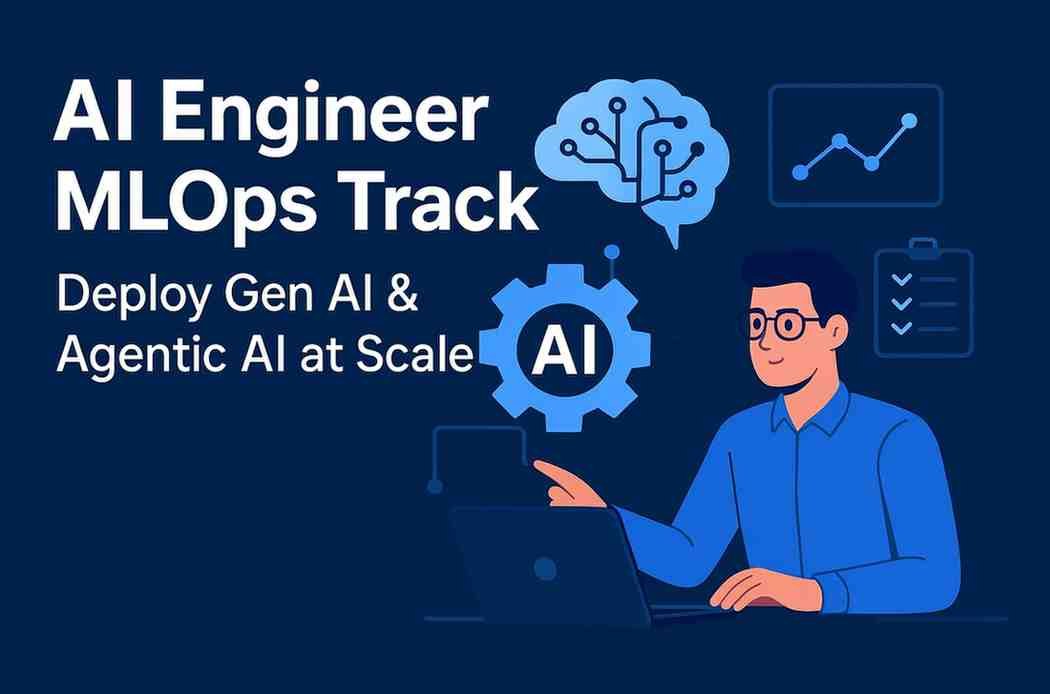
AI Engineer MLOps Track: Deploy Gen AI & Agentic AI at Scale is a Udemy course designed for this exact stage of the AI lifecycle. Rather than focusing on prompts or isolated models, the course teaches how to deploy, manage, monitor, and scale AI systems that are used by real users.
This in-depth review explores what the course delivers, how practical it is, and whether it prepares learners for real-world AI engineering and MLOps roles.
Course Overview
This course is built for developers and AI engineers who want to move beyond experimentation and into production-grade AI systems. It combines concepts from:
-
MLOps
-
Generative AI deployment
-
Agentic AI architecture
-
Monitoring and optimization
The core focus is not just on building AI applications, but on running them reliably at scale.
You will learn how to take AI systems from:
“It works on my laptop” → “It runs in production with users”
This makes the course particularly valuable for professionals aiming to work in enterprise, startup, or platform engineering roles.
What You Will Learn in This Course
1. Production Mindset for Generative & Agentic AI
The course starts by establishing a realistic perspective on deploying AI systems.
You will learn:
-
Why Gen AI fails in production environments
-
Key challenges of scaling LLM-based applications
-
Differences between experimental and production AI
-
Architecture patterns for reliable AI systems
This foundational mindset is crucial for professional AI engineering.
2. MLOps for Generative AI Systems
Unlike traditional ML models, Gen AI introduces new operational challenges.
The course covers:
-
MLOps principles adapted for LLM-based applications
-
Model lifecycle management for Gen AI
-
Versioning prompts, models, and configurations
-
Reproducibility and rollback strategies
This section helps learners move from ad-hoc deployments to disciplined engineering workflows.
3. Deploying Generative AI Applications
A key strength of the course is its production-focused deployment strategy.
You will learn:
-
Packaging AI applications for deployment
-
Containerization concepts for AI workloads
-
Serving LLM-powered APIs
-
Managing inference performance and latency
These lessons are vital for building AI services that users can depend on.
4. Deploying and Managing Agentic AI Systems
Agentic AI introduces additional operational complexity.
The course explores:
-
Deploying multi-step AI agents
-
Managing agent execution lifecycles
-
Handling failures and retries
-
Orchestrating agent workflows
-
Ensuring predictable agent behavior
This section distinguishes experimental agents from production-ready agent systems.
5. Scalability & Infrastructure Considerations
Scaling AI systems is not just about compute—it’s about architecture.
You’ll learn:
-
Horizontal vs vertical scaling for AI workloads
-
Infrastructure trade-offs for AI services
-
Load handling strategies
-
Cost-aware scaling decisions
This prepares learners to deploy AI systems responsibly and efficiently.
6. Observability, Monitoring & Debugging
Monitoring AI systems is more complex than traditional software.
The course teaches:
-
Observability strategies for Gen AI systems
-
Monitoring latency, errors, and usage
-
Detecting hallucinations and degraded responses
-
Debugging production AI behavior
This is one of the most valuable sections for real-world deployment readiness.
7. Security, Reliability & Governance
Production AI systems must meet enterprise standards.
You will learn:
-
Securing AI APIs and services
-
Managing sensitive data in AI pipelines
-
Reliability and uptime considerations
-
Guardrails for AI misuse
-
Responsible deployment practices
This makes the course suitable for regulated and enterprise environments.
8. Real-World Production Scenarios
The course ties concepts together through realistic, applied scenarios.
Projects and examples focus on:
-
End-to-end AI deployment workflows
-
Production architecture design
-
Common failure modes and solutions
-
Lessons from real AI systems
These examples make the learning directly transferable to the workplace.
Teaching Style & Learning Experience
The teaching approach is:
-
Engineering-driven and pragmatic
-
Focused on system reliability, not demos
-
Structured around real-world use cases
-
Clear, logical, and implementation-focused
This is not a hype-driven course—it assumes learners want to build AI systems that actually run in production.
Pros and Cons
✅ Pros
-
Strong focus on production and deployment
-
Covers both Generative and Agentic AI
-
Excellent introduction to AI-focused MLOps
-
Real-world architecture and scaling strategies
-
Emphasis on monitoring and reliability
-
Job-relevant for modern AI roles
❌ Cons
-
Not beginner-friendly for non-engineers
-
Requires prior exposure to AI/LLMs
-
Minimal coverage of model training from scratch
-
More backend and infrastructure focused
Who Should Take This Course?
This course is ideal for:
-
AI engineers and ML engineers
-
MLOps engineers
-
Backend developers working with AI
-
DevOps professionals entering AI systems
-
Teams deploying AI products
Who Should Avoid This Course?
This course may not be suitable if:
-
You are new to programming or Python
-
You only want prompt engineering skills
-
You prefer theoretical AI coursework
-
You are looking for no-code AI solutions
Skills You Will Gain After Completion
After finishing this course, learners will be able to:
-
Deploy generative AI applications in production
-
Operate and scale agentic AI systems
-
Apply MLOps principles to LLM workloads
-
Monitor and debug AI services
-
Design secure, reliable AI architectures
These capabilities are directly aligned with production AI engineering roles.
Is the AI Engineer MLOps Track Worth It?
If your goal is to deploy and manage real AI systems at scale, this course offers substantial value. While many AI courses focus on models and prompts, this one focuses on what actually matters in the real world: reliability, scalability, and operations.
For professionals serious about AI engineering careers, this course fills a critical skills gap.
Summary
AI Engineer MLOps Track: Deploy Gen AI & Agentic AI at Scale is a practical, forward-looking course that addresses one of the most important challenges in modern AI—production deployment. It equips learners with the engineering mindset and operational skills needed to move AI from proof-of-concept to real-world impact.
For anyone aiming to work on production AI systems, this course is a strong and future-proof learning investment.

Reviews
There are no reviews yet.