




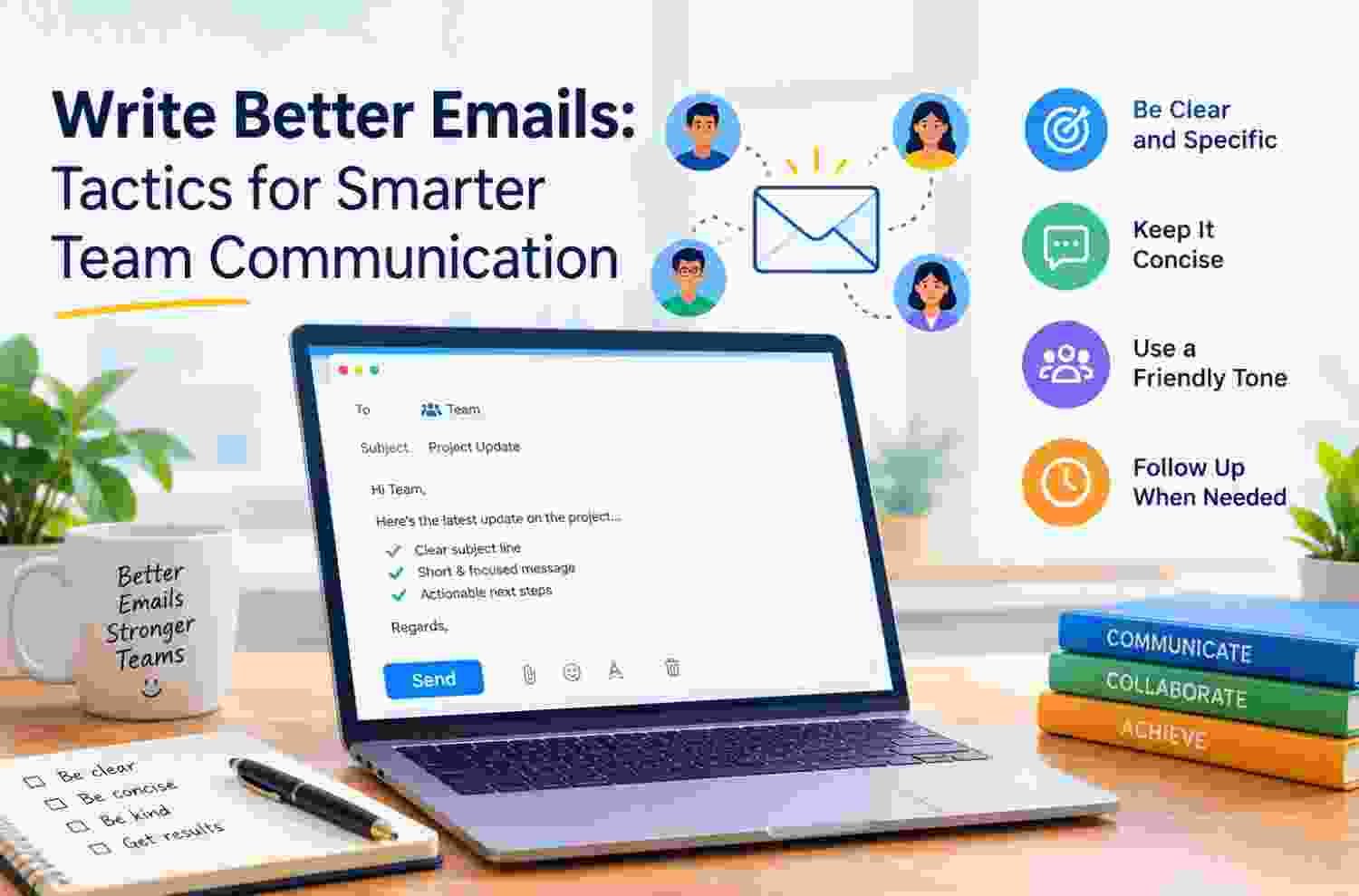
Description
Introduction
Email remains one of the most important communication tools in the modern workplace. Despite the popularity of instant messaging, video meetings, and collaboration platforms, professionals still rely heavily on email to share information, make decisions, coordinate projects, communicate with customers, and document important conversations.
However, writing an email is easy. Writing an effective professional email is much harder.
A poorly written email can create confusion, lead to unnecessary follow-ups, waste time, or even damage professional relationships. On the other hand, a clear and well-structured email can communicate an idea quickly, encourage action, and make workplace collaboration considerably more efficient.
Write Better Emails Course Overview
The central idea behind the course is straightforward: better email communication can lead to better teamwork.
Professional emails should not simply contain information. They should make it easy for the recipient to understand the situation, identify what is required, and determine what needs to happen next.
The course focuses on improving the way professionals approach email communication rather than simply teaching grammar or vocabulary.
It is particularly relevant for people who regularly communicate with colleagues, managers, clients, customers, or other business stakeholders.
The lessons can help learners think more strategically about the emails they send and develop habits that make workplace communication more efficient.
What Will You Learn in Write Better Emails?
The course is focused on improving practical email-writing and communication skills.
Key areas covered include:
- Writing clearer professional emails
- Structuring workplace messages effectively
- Making emails more concise
- Communicating information with greater clarity
- Creating effective email messages
- Making requests easier to understand
- Reducing unnecessary back-and-forth communication
- Improving team communication
- Communicating with greater confidence
- Avoiding common email-writing mistakes
- Writing messages that encourage appropriate action
- Developing smarter workplace communication habits
The emphasis on tactics makes the course particularly useful for professionals who already send emails every day but feel that their messages could be more effective.
Why Better Email Writing Matters
Email is asynchronous communication.
Unlike a face-to-face conversation, the recipient may read your message hours later without having the context that was obvious to you when you wrote it.
This creates several potential problems.
An unclear email can result in:
- Follow-up questions
- Missed deadlines
- Misunderstandings
- Incorrect assumptions
- Delayed decisions
- Repeated conversations
- Unnecessary meetings
A well-written email can reduce these problems by presenting information in a logical and actionable format.
For teams, this becomes particularly important because a large amount of organizational knowledge and decision-making is communicated through written messages.
Course Content and Learning Approach
One of the main strengths of this course is its practical subject matter.
Most professionals don’t need another theoretical communication course. They need techniques they can use when writing their next email.
The course approaches email communication from a practical workplace perspective.
Instead of simply focusing on spelling and grammar, learners are encouraged to think about the purpose of an email, the recipient, the information being communicated, and the desired outcome.
This approach makes the course relevant to real-world business communication.
Writing Clearer Emails
Clarity is arguably the most important characteristic of an effective professional email.
A recipient should not have to read an email multiple times to determine what the sender is trying to communicate.
Clear writing generally involves:
- A specific purpose
- Logical organization
- Relevant information
- Simple language
- Clear requests
- Appropriate context
- A recognizable next step
The course helps learners develop a more deliberate approach to email writing.
This can be especially useful when communicating complex information or coordinating work across multiple people.
Making Emails More Concise
Long emails are not necessarily bad, but unnecessary information can make important messages harder to understand.
Professionals often write longer emails because they want to include every detail.
The problem is that the recipient may struggle to identify which information actually matters.
Learning to distinguish between essential information and supporting details can make emails substantially more effective.
Concise communication can help recipients:
- Understand the message faster
- Identify important information
- Respond more quickly
- Take the appropriate action
- Avoid unnecessary clarification
This is particularly valuable in busy workplace environments.
Improving Team Communication
The course title emphasizes smarter team communication, and this is an important aspect of professional email writing.
Team communication is not simply about exchanging information.
It is about ensuring that everyone understands:
- What is happening
- Why it matters
- Who is responsible
- What needs to happen
- When it needs to happen
Poorly structured emails can make team coordination difficult.
A more deliberate approach to writing can make responsibilities and next steps clearer.
This can be particularly useful for project teams, remote teams, cross-functional departments, and distributed organizations.
Writing Better Requests
Many professional emails require the recipient to take some form of action.
You might need someone to:
- Review a document
- Approve a proposal
- Provide information
- Complete a task
- Attend a meeting
- Make a decision
- Respond to a question
If the request is buried inside a long message, the recipient may overlook it.
Effective email communication makes the required action easy to identify.
The course can help learners become more intentional about how they formulate requests and communicate expectations.
Reducing Email Back-and-Forth
One of the hidden costs of poor email writing is unnecessary communication.
For example, an employee sends a vague request.
The recipient asks for clarification.
The employee responds with additional information.
The recipient asks another question.
A simple request can turn into a long email thread.
Better email structure can reduce this type of communication overhead by providing the necessary context from the beginning.
This is one of the most practical benefits of improving professional email skills.
Professional Email Tone
The tone of an email can significantly affect how the message is perceived.
The same information can sound:
- Helpful
- Aggressive
- Defensive
- Unclear
- Professional
- Impatient
depending on how it is written.
Professional email communication requires a balance between clarity and appropriate tone.
You generally want to communicate directly without sounding unnecessarily harsh.
At the same time, excessive politeness can sometimes make a message vague.
Learning how to balance these factors is an important professional communication skill.
Who Should Take This Course?
Working Professionals
This is probably the most obvious audience for the course.
If you send multiple emails every day, even small improvements in your writing can save time and improve collaboration.
Managers and Team Leaders
Managers regularly use email to communicate priorities, provide updates, assign responsibilities, and coordinate teams.
Better email-writing skills can help managers communicate expectations more effectively.
Project Managers
Project management involves continuous communication.
Project managers need to communicate deadlines, responsibilities, risks, updates, decisions, and requests.
Clear emails can make project coordination considerably easier.
Entrepreneurs and Business Owners
Business owners communicate with employees, customers, suppliers, partners, vendors, and other stakeholders.
Professional written communication can influence how a company is perceived.
Freelancers and Consultants
Freelancers frequently communicate with clients through email.
Clear communication can help establish expectations, explain deliverables, manage revisions, and maintain professional relationships.
Job Seekers and Students
Email skills are useful even before entering a full-time career.
Students and job seekers may need to write:
- Internship inquiries
- Networking emails
- Interview follow-ups
- Professional requests
- Application-related messages
Learning professional email etiquette early can be a valuable advantage.
Pros of Write Better Emails
1. Highly Practical Topic
Email writing is a skill that professionals can use immediately.
You don’t need to wait for a specific project or situation to apply what you learn.
2. Useful Across Industries
Email communication is relevant to almost every professional field.
The principles can be applied in:
- Technology
- Finance
- Marketing
- Education
- Consulting
- Healthcare
- Sales
- Administration
- Entrepreneurship
3. Focuses on Workplace Communication
The course is particularly relevant to people who communicate with teams and colleagues regularly.
4. Can Improve Productivity
Clearer emails can reduce unnecessary clarification and help recipients understand what needs to happen.
5. Beginner-Friendly Skill
You don’t need previous communication training to benefit from the course.
Anyone who regularly writes professional emails can potentially apply the techniques.
Potential Limitations
Not a General English Course
This course should not be considered a complete English-language or grammar program.
If your primary challenge is grammar, vocabulary, pronunciation, or general English fluency, you may need a separate course.
Practice Is Required
Watching a course about email writing doesn’t automatically make someone a better writer.
The techniques need to become habits.
The best way to benefit is to apply the principles to your actual workplace emails.
Email Is Only One Communication Channel
Modern teams communicate through email, messaging applications, video meetings, project-management systems, and collaborative documents.
Therefore, better email writing should be viewed as one component of broader professional communication skills.
How to Get the Most From the Course
To maximize the value of the course, don’t simply watch the lessons from beginning to end.
Use your existing emails as practice material.
Step 1: Review Your Recent Emails
Look at several emails you’ve written recently.
Identify messages that resulted in unnecessary questions or follow-ups.
Step 2: Identify the Problem
Ask yourself whether the issue was caused by:
- Lack of context
- Poor structure
- Unclear wording
- Missing information
- An unclear request
- Excessive length
Step 3: Apply the Course Techniques
Rewrite some of those messages using the principles taught in the course.
Step 4: Compare the Results
Look at the original and revised versions.
The goal should be clearer communication, not simply shorter emails.
Step 5: Build a Habit
Eventually, the techniques should become part of your normal writing process.
Is Write Better Emails Worth It?
For professionals who spend significant time communicating through email, Write Better Emails: Tactics for Smarter Team Communication can be a worthwhile investment.
The subject is highly practical and directly connected to everyday professional activities.
The course is particularly valuable for people who frequently experience problems such as long email threads, unclear requests, missed information, or repeated clarification.
Its value ultimately depends on implementation.
If you watch the course and continue writing emails exactly as before, the benefit will be limited. If you apply the techniques to your daily communication, the course can help you become more efficient and intentional with professional email.
Final Verdict
Write Better Emails: Tactics for Smarter Team Communication is a practical course for anyone who wants to improve professional email communication.
Its biggest advantage is its immediate applicability. Email is a daily responsibility for millions of professionals, and even small improvements in clarity, structure, tone, and action-oriented writing can make workplace communication more efficient.
The course is especially suitable for employees, managers, project managers, entrepreneurs, freelancers, consultants, and anyone who regularly communicates with teams or clients through email.