




Description
Introduction
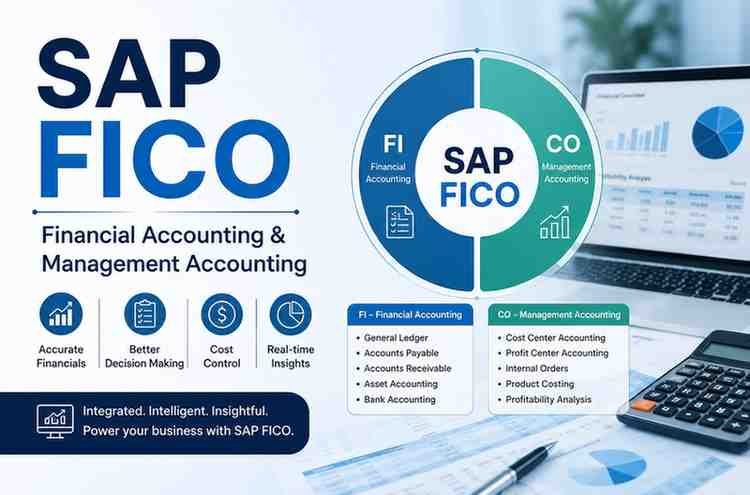
SAP FICO (Financial Accounting & Management Accounting) is one of the most in-demand enterprise resource planning (ERP) modules used by organizations worldwide to manage financial reporting, accounting operations, and internal cost control. The SAP FICO Training Course is designed to help learners understand how financial processes are executed inside the SAP environment, combining both Financial Accounting (FI) and Controlling (CO) modules into a structured learning path.
This course focuses on practical system knowledge, enabling learners to understand real business workflows used by finance teams in large enterprises.
What You Will Learn
The course covers both theoretical accounting concepts and their practical implementation within SAP.
Main learning outcomes include:
-
Understanding SAP ERP architecture and navigation
-
Financial Accounting (FI) module fundamentals
-
General ledger accounting processes
-
Accounts payable and accounts receivable workflows
-
Asset accounting concepts
-
Bank accounting and financial transactions
-
Management accounting using the Controlling (CO) module
-
Cost center and profit center accounting
-
Internal orders and cost tracking
-
Financial reporting within SAP
Learners gain exposure to how large organizations manage financial data in integrated ERP systems.
Course Curriculum Breakdown
1. SAP Basics and System Navigation
The course begins with an introduction to SAP ERP concepts, system interface navigation, and organizational structure within SAP. This helps beginners understand how business processes are mapped inside the system.
2. Financial Accounting (FI) Module
This section focuses on external financial reporting and accounting operations.
Topics include:
-
General Ledger configuration and postings
-
Vendor and customer accounting
-
Invoice processing workflows
-
Payment processing and reconciliation
-
Financial document management
Students learn how accounting transactions flow through SAP and impact financial statements.
3. Management Accounting (CO) Module
The Controlling module focuses on internal financial management and cost monitoring.
Key areas covered:
-
Cost center accounting
-
Profit center analysis
-
Internal order management
-
Cost allocation processes
-
Budget tracking and performance monitoring
This module helps learners understand how organizations analyze operational efficiency and profitability internally.
4. Integration Between FI and CO
One of SAP FICO’s most important concepts is integration. The course demonstrates how financial accounting data automatically connects with controlling processes, ensuring consistent reporting across departments.
5. Reporting and Business Insights
Learners also explore financial reporting tools within SAP, helping them understand how managers generate insights and make strategic decisions based on real-time data.
Teaching Style & Learning Experience
The instructor adopts a practical demonstration-based teaching style. Lessons combine conceptual explanations with SAP screen walkthroughs, allowing learners to visualize real workflows.
Key strengths of the learning experience include:
-
Step-by-step system demonstrations
-
Realistic business process examples
-
Clear explanation of accounting logic inside SAP
-
Beginner-friendly progression
-
Practical orientation toward job roles
The structured approach helps learners gradually build confidence with ERP financial operations.
Who This Course Is Best For
This training is ideal for:
-
Accounting and finance professionals entering SAP careers
-
Commerce graduates seeking ERP skills
-
SAP aspirants preparing for consultant roles
-
Financial analysts working with ERP systems
-
MBA or finance students expanding technical skills
-
Professionals transitioning into enterprise finance roles
No prior SAP experience is required, though basic accounting knowledge is helpful.
Skills You Gain After Completion
After completing the course, learners typically understand how to:
-
Navigate SAP ERP financial modules
-
Process accounting transactions within SAP
-
Manage accounts payable and receivable workflows
-
Perform cost tracking and internal reporting
-
Understand FI–CO integration
-
Support financial operations in enterprise environments
These skills align with entry-level SAP FICO consultant and SAP finance analyst roles.
Key Advantages
✅ High Industry Demand Skill
SAP FICO knowledge is widely required across multinational companies and large enterprises.
✅ Practical ERP Exposure
Learners see how accounting works inside real business software rather than only theory.
✅ Career-Oriented Training
Provides foundational knowledge useful for SAP consulting and finance system roles.
✅ Structured Learning Path
Covers both external financial accounting and internal controlling processes.
Potential Limitations
-
Advanced SAP configuration topics may require additional specialized courses.
-
Hands-on system practice depends on learner access to SAP environments outside the course.
-
Beginners without accounting knowledge may need extra time to understand finance terminology.
Career Value and Industry Relevance
ERP systems like SAP form the backbone of financial operations in large organizations. Professionals who understand both accounting principles and SAP execution are highly valued because they bridge business and technology functions.
Learning SAP FICO opens opportunities in roles such as:
-
SAP FICO Consultant
-
ERP Finance Analyst
-
Financial Systems Specialist
-
Accounts Process Analyst
-
Corporate Finance Operations
The combination of accounting and ERP knowledge significantly enhances career competitiveness.
Summary
SAP FICO (Financial Accounting & Management Accounting) is a strong foundational course for anyone aiming to enter the SAP finance ecosystem. By combining accounting concepts with system-based execution, it provides practical insight into how enterprise financial processes operate in real organizations.

Reviews
There are no reviews yet.