



Description
In today’s data-driven world, understanding time-based data is no longer optional. From stock prices and sales forecasts to demand planning and anomaly detection, time series analysis sits at the heart of business intelligence, data science, and machine learning applications.
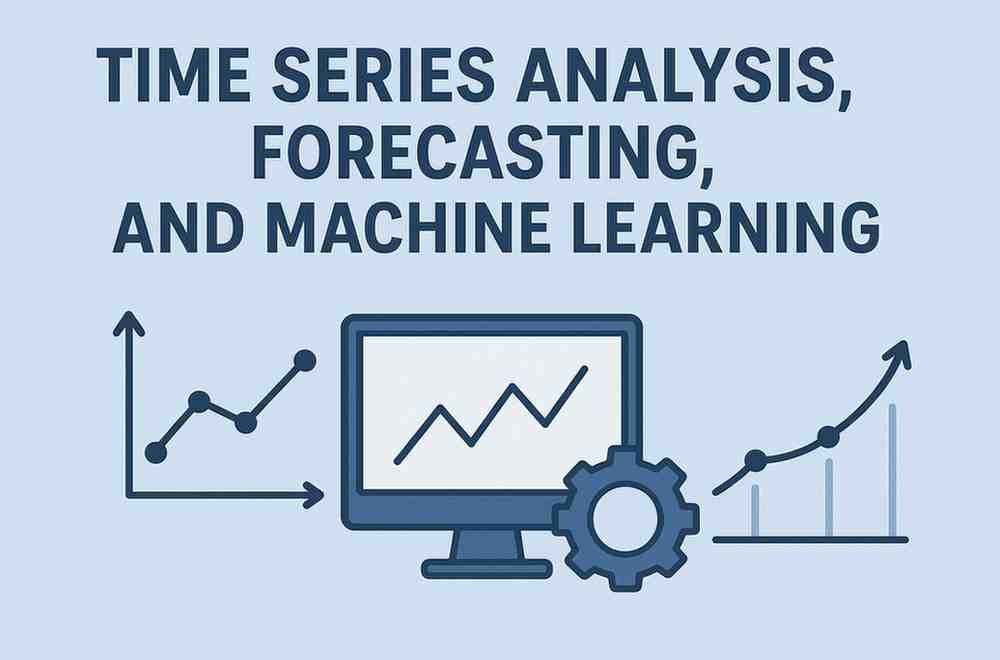
Time Series Analysis, Forecasting, and Machine Learning is a comprehensive Udemy course designed to help learners master both classical forecasting techniques and modern machine learning approaches for time-dependent data. This course is widely chosen by students who want practical, job-relevant skills rather than purely academic theory.
In this review, we break down the course structure, learning outcomes, real-world relevance, and who this course is best suited for.
Course Overview
This course focuses on end-to-end time series modeling, starting from raw data understanding and moving toward advanced forecasting using statistical models and machine learning techniques.
The curriculum is designed to:
-
Explain time series concepts in a clear and intuitive way
-
Balance theory with hands-on implementation
-
Apply techniques to real-world datasets
-
Bridge the gap between traditional forecasting and ML-based approaches
Rather than treating time series as an abstract topic, the course emphasizes practical decision-making and predictive accuracy, which is critical for real business scenarios.
What You Will Learn in This Course
1. Foundations of Time Series Analysis
The course begins with a strong conceptual foundation.
You will learn:
-
What time series data is and how it differs from regular datasets
-
Key components such as trend, seasonality, cycles, and noise
-
Stationarity and why it matters
-
Autocorrelation and partial autocorrelation concepts
These fundamentals ensure learners understand why certain models work instead of blindly applying formulas.
2. Time Series Data Preprocessing
Real-world time series data is rarely clean.
The course covers:
-
Data cleaning for time-based datasets
-
Handling missing timestamps and values
-
Resampling and frequency conversion
-
Smoothing techniques
-
Rolling statistics and transformations
This section is extremely useful for professionals dealing with messy production data.
3. Statistical Forecasting Models
A major strength of this course is its coverage of classical forecasting techniques.
You will learn:
-
Moving averages and weighted averages
-
Exponential smoothing methods
-
AR, MA, ARMA, and ARIMA models
-
Seasonal ARIMA (SARIMA)
-
Model diagnostics and residual analysis
Concepts are explained step by step, making even complex models approachable for beginners and intermediates.
4. Forecast Evaluation & Model Selection
Forecasting accuracy is critical in real applications.
The course teaches:
-
Error metrics such as MAE, RMSE, and MAPE
-
Cross-validation strategies for time series
-
Overfitting vs underfitting in temporal data
-
Model comparison techniques
This helps learners choose models based on performance rather than assumptions.
5. Introduction to Machine Learning for Time Series
After covering statistical approaches, the course transitions into machine learning.
Topics include:
-
Feature engineering for time series
-
Lag features and rolling windows
-
Supervised learning applied to temporal data
-
Training ML models for forecasts
-
Limitations of ML in time-dependent contexts
This section bridges traditional forecasting and modern ML workflows.
6. Advanced Time Series Techniques
The course also explores advanced ideas used in industry settings.
You will learn:
-
Trend and seasonality decomposition methods
-
Handling multiple seasonal patterns
-
Anomaly detection fundamentals
-
Multivariate time series modeling
-
Forecasting with external regressors
These techniques add depth and real-world applicability to the learning experience.
7. Hands-On Implementation & Practical Examples
Practical learning is a major highlight of this course.
You’ll work with:
-
Realistic datasets
-
End-to-end forecasting pipelines
-
Visualization of trends and patterns
-
Model interpretation and improvement
By the end, learners are comfortable turning raw time-based data into actionable forecasts.
Teaching Style & Learning Experience
The instructor’s teaching approach is:
-
Clear and logically structured
-
Concept-first, implementation-second
-
Focused on intuition, not memorization
-
Practical rather than overly academic
Complex mathematics is simplified, making the course accessible without sacrificing depth.
Pros and Cons
✅ Pros
-
Strong conceptual foundation
-
Balanced mix of theory and practice
-
Excellent explanation of ARIMA-based models
-
Real-world forecasting perspective
-
Suitable for both beginners and intermediate learners
-
Highly applicable to finance, operations, and analytics
❌ Cons
-
Deep learning models are not the main focus
-
Requires patience for understanding classical models
-
Some sections may feel technical for non-analytical learners
Who Should Take This Course?
This course is ideal for:
-
Data analysts and business analysts
-
Aspiring data scientists
-
Machine learning practitioners
-
Finance and supply chain professionals
-
Engineers working with time-based data
Who Should Avoid This Course?
You may want to reconsider if:
-
You want only deep learning or neural networks
-
You are looking for a purely statistical or academic course
-
You are completely new to Python or data analysis
-
You prefer short, tool-only tutorials
Skills You Will Gain After Completion
After completing this course, you will be able to:
-
Analyze and interpret time series data
-
Build reliable forecasting models
-
Apply ARIMA and seasonal models correctly
-
Engineer features for ML-based forecasts
-
Evaluate and improve prediction accuracy
-
Handle real-world forecasting problems confidently
These skills are highly valued across analytics, finance, and machine learning roles.
Is This Course Worth It?
If your goal is to truly understand time series forecasting and apply it confidently in real projects, this course delivers strong value. Its emphasis on fundamentals, model reasoning, and evaluation makes it especially useful for professionals who need dependable forecasts rather than black-box predictions.
Summary
Time Series Analysis, Forecasting, and Machine Learning is a well-structured, practical, and intellectually solid course. It equips learners with the skills needed to predict future outcomes from time-based data using both classical and modern approaches.
For anyone serious about analytics, forecasting, or applied machine learning, this course is a smart learning investment.