



Description
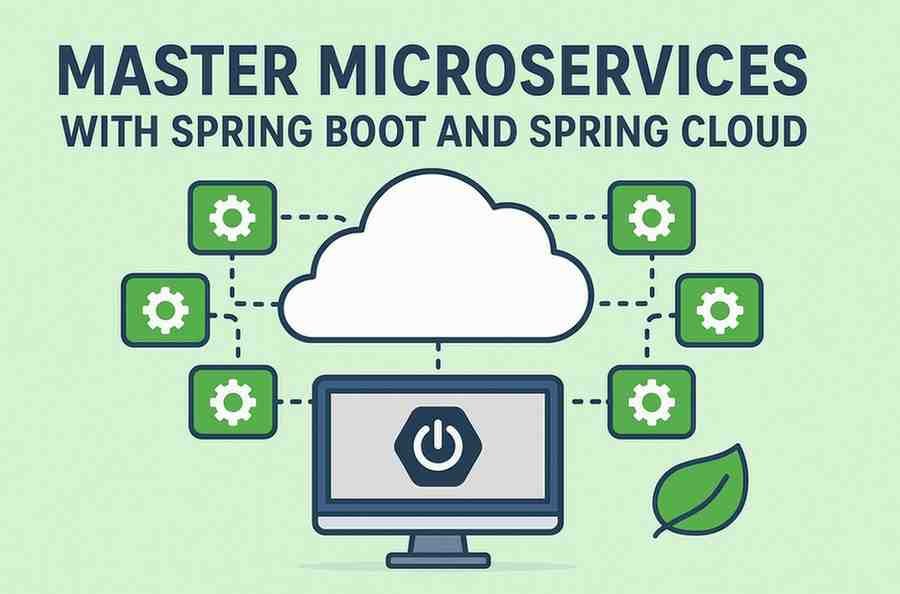
As modern applications scale, monolithic architectures often become difficult to maintain, deploy, and evolve. This has led to widespread adoption of microservices architecture, especially in Java-based enterprise environments. Master Microservices with Spring Boot and Spring Cloud is a Udemy course designed to help developers understand not just how to build microservices, but how to design them correctly using industry-standard tools.
In this detailed review, we’ll explore what the course teaches, how practical it is, who should take it, and whether it justifies the time and investment.
Course Overview
This course focuses on building real-world microservices applications using Spring Boot and Spring Cloud. Rather than just introducing frameworks, the course walks learners through the architectural decisions, patterns, and challenges involved in distributed systems.
It emphasizes:
-
Designing loosely coupled services
-
Managing configuration and communication
-
Handling failures gracefully
-
Scaling applications for production use
The course uses a hands-on, build-as-you-learn approach, making complex microservices concepts easier to understand.
What You’ll Learn in This Course
1. Microservices Architecture Fundamentals
The course starts with core architectural concepts to ensure learners understand why microservices are used.
You’ll learn:
-
Monolithic vs microservices architecture
-
Benefits and trade-offs of microservices
-
Service boundaries and responsibilities
-
Common anti-patterns and mistakes
-
Real-world use cases
This foundational section provides important context before writing any code.
2. Spring Boot for Microservices
Spring Boot is used as the primary framework for creating microservices efficiently.
Topics include:
-
Setting up Spring Boot projects
-
Building RESTful web services
-
Handling requests and responses
-
Validations and exception handling
-
Writing clean, production-grade APIs
Spring Boot’s auto-configuration helps reduce boilerplate and speeds up development.
3. Spring Cloud & Service Discovery
One of the highlighted strengths of the course is its coverage of Spring Cloud components.
You’ll explore:
-
Service registration and discovery
-
Centralized configuration management
-
Distributed configuration updates
-
Managing multiple environments
These tools play a crucial role in large microservices ecosystems.
4. Inter-Service Communication
Communication between services is a core challenge in microservices systems.
The course covers:
-
REST-based synchronous communication
-
Load balancing techniques
-
Handling network latency and failures
-
Fault tolerance and resilience patterns
Learners gain a practical understanding of how microservices interact reliably.
5. Resilience, Fault Tolerance & Monitoring
The course places strong importance on handling failures—an inevitable part of distributed systems.
Key topics include:
-
Circuit breakers and retries
-
Monitoring service health
-
Designing for fault tolerance
-
Graceful degradation strategies
These concepts help developers build systems that remain stable under stress.
6. API Gateway & Security
To manage multiple services efficiently, the course explains gateway and security patterns.
You’ll learn:
-
API Gateway concepts
-
Routing requests across services
-
Securing microservices
-
Managing authentication and authorization
This reflects how real-world enterprises protect and manage microservices environments.
7. Distributed Tracing & Observability
Understanding system behavior across services is essential in production.
The course introduces:
-
Logging in distributed systems
-
Tracking requests across multiple services
-
Monitoring performance bottlenecks
-
Improving observability
These lessons prepare learners for real production debugging scenarios.
8. Deployment & Scaling Considerations
While the course is not cloud-specific, it introduces production readiness concepts.
You’ll cover:
-
Configuring services for deployment
-
Handling environment differences
-
Scaling microservices applications
-
Architectural considerations for cloud platforms
This helps bridge the gap between development and real-world deployment.
Teaching Style & Learning Experience
The teaching approach is:
-
Structured and systematic
-
Architecture-focused
-
Practical and example-driven
-
Suitable for enterprise-level development
Concepts are explained using diagrams first and then translated into code, making even advanced topics accessible.
Pros and Cons
✅ Pros
-
Strong focus on real-world microservices architecture
-
Excellent Spring Boot and Spring Cloud coverage
-
Clear explanations of complex system concepts
-
Hands-on, practical learning
-
Ideal for enterprise Java developers
❌ Cons
-
Not suitable for beginners in Java
-
Requires prior Spring Boot knowledge
-
Frontend aspects are minimal
-
Concepts may feel complex initially
Who Should Take This Course?
This course is best suited for:
-
Java developers working with Spring Boot
-
Backend engineers transitioning to microservices
-
Enterprise developers handling large systems
-
Architects preparing for distributed systems design
-
Professionals looking to modernize Java applications
Who Should Avoid This Course?
You may want to reconsider if:
-
You are new to Java or Spring
-
You prefer beginner-level tutorials
-
You are focused purely on frontend development
-
You want a short crash course
Skills You’ll Gain After Completion
After finishing the course, learners can:
-
Design scalable microservices architectures
-
Build independent Spring Boot services
-
Use Spring Cloud for configuration and discovery
-
Implement fault tolerance and resilience
-
Secure and monitor distributed systems
These are valuable skills for enterprise-level and cloud-native development roles.
Is Master Microservices with Spring Boot and Spring Cloud Worth It?
If you’re a Java developer looking to move beyond basic REST APIs into scalable, enterprise-ready systems, this course offers excellent depth and practical value. It focuses on the realities of microservices rather than oversimplified examples.
This course is not about shortcuts—it’s about building systems the right way.
Summary
Master Microservices with Spring Boot and Spring Cloud is a well-structured, practical, and professional-grade course that delivers strong architectural and implementation insights. For developers serious about distributed systems using Java, this course is a solid investment.