




Description
Course Overview
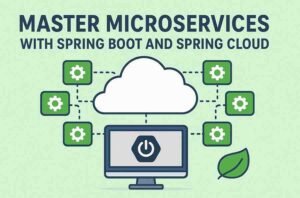
If you are a Java developer who already understands Spring and Spring Boot and want to move into microservices architecture, Master Microservices with Spring Boot and Spring Cloud is a comprehensive course worth considering.
Created by in28Minutes Official, the course takes a practical approach to learning microservices using the Spring ecosystem. It covers REST APIs, Spring Boot, Spring Cloud, Docker, Kubernetes, and several important microservices patterns.
Rather than concentrating only on theoretical concepts, the course focuses heavily on building applications and understanding how different components work together in a distributed architecture.
But is this course the right choice for you? Let’s take a closer look.
What Will You Learn?
One of the biggest strengths of this course is its extensive syllabus.
Instead of immediately jumping into Spring Cloud, the course establishes a foundation in REST and Spring Boot before gradually introducing microservices architecture.
The course covers several technologies and concepts, including:
- Java
- Spring Boot
- REST APIs
- Spring Cloud
- Eureka
- API Gateway
- Feign
- Resilience4J
- Zipkin
- Docker
- Kubernetes
The broad curriculum makes it particularly suitable for developers who already understand Java and Spring Boot and want to learn how distributed applications are designed and implemented.
RESTful Web Services
The course introduces the fundamentals of RESTful web services before moving into more advanced microservices concepts.
You learn about:
- REST architecture
- HTTP methods
- Request and response handling
- JSON and XML
- REST resources
- HTTP status codes
- REST API design
This foundation is useful because REST APIs are commonly used for communication between applications and services.
Building REST APIs with Spring Boot
After learning REST fundamentals, the course moves into practical Spring Boot development.
You learn how to create and structure RESTful services using Spring Boot and work with concepts such as:
- Controllers
- Resources
- Validation
- Exception handling
- Filtering
- HATEOAS
- API versioning
- Spring Boot Actuator
- API documentation
This section is valuable even if you are not immediately planning to build microservices because REST API development is an important backend development skill.
Introduction to Microservices Architecture
The course then transitions from individual REST services to distributed microservices.
This is particularly useful for developers who have primarily worked with monolithic applications.
The course introduces concepts such as:
- Microservice architecture
- Independent services
- Service-to-service communication
- Service discovery
- Configuration management
- Load balancing
- API gateways
- Fault tolerance
- Distributed tracing
The practical approach helps demonstrate why these components become necessary as an application grows.
Spring Cloud
Spring Cloud is one of the central parts of the course.
It introduces several technologies designed to solve common challenges associated with distributed systems.
Spring Cloud Config
Managing configuration becomes more complicated when an application consists of multiple independent services.
The course demonstrates centralized configuration using Spring Cloud Config.
This allows configuration to be managed separately from individual services and makes it easier to maintain consistent application settings.
Eureka Naming Server
Service discovery is an important part of microservices architecture.
Instead of manually configuring the location of every service, services can register themselves with a discovery server and dynamically locate other services.
The course demonstrates this concept using Eureka.
API Gateway
An API Gateway provides a centralized entry point for clients communicating with multiple microservices.
The course demonstrates how an API Gateway can route incoming requests to the appropriate backend services.
This introduces an important architectural pattern used in many distributed applications.
Load Balancing
The course also introduces load-balancing concepts.
When multiple instances of a microservice are running, requests can be distributed among them rather than sending every request to a single instance.
This helps introduce the concepts of scalability and high availability.
Feign REST Client
Feign provides a convenient way for one microservice to communicate with another.
Instead of manually constructing and managing HTTP requests, developers can create declarative clients.
The course demonstrates how Feign can simplify communication between Spring Boot microservices.
Distributed Tracing with Zipkin
Debugging a monolithic application can already be challenging.
With microservices, a single user request may travel through several independent services.
The course introduces distributed tracing using Zipkin to help track requests across multiple services.
This is particularly useful for understanding how observability works in distributed architectures.
Fault Tolerance with Resilience4J
One of the biggest challenges with microservices is handling service failures.
If one service becomes unavailable, dependent services should ideally be able to handle the situation gracefully.
The course introduces Resilience4J and fault-tolerance concepts to demonstrate how applications can become more resilient when dependencies fail.
Docker and Containerization
Docker is another major part of the course.
You learn how to package applications into containers and work with containerized microservices.
This creates an important connection between application development and deployment:
Spring Boot → Microservices → Docker Containers
Understanding this workflow is increasingly useful for developers working with cloud-native applications.
Kubernetes
The course also introduces Kubernetes for managing containerized applications.
You learn the fundamentals of deploying and managing microservices in a Kubernetes environment.
Topics include concepts related to:
- Container orchestration
- Deployment
- Scaling
- Service management
- Kubernetes architecture
The Kubernetes section provides a foundation for further study rather than attempting to cover every advanced Kubernetes capability.
Monitoring REST Services
The course covers Spring Boot Actuator for monitoring and managing Spring Boot applications.
This is important because monitoring becomes increasingly critical as an application moves from a single service to a distributed architecture.
Developers need to understand not only how to build services but also how to monitor their health and behavior.
REST API Best Practices
Another useful part of the course is its focus on REST API design.
You learn concepts related to:
- API versioning
- Validation
- Exception handling
- Filtering
- HATEOAS
- API documentation
- HTTP status codes
- REST design practices
These concepts remain useful for backend developers regardless of whether they ultimately work with microservices.
Course Structure and Teaching Approach
The course follows a logical progression.
The overall learning path can be summarized as:
REST Fundamentals → Spring Boot → REST APIs → Microservices → Spring Cloud → Docker → Kubernetes
This structure makes sense because each topic builds upon the previous one.
You first learn how to create an individual service.
Then you learn what happens when multiple services need to communicate with each other.
Finally, you learn technologies that help manage, monitor, deploy, and scale those services.
The practical approach is particularly helpful because microservices architecture can be difficult to understand through theory alone.
What Makes This Course Stand Out?
Comprehensive Technology Coverage
The biggest strength of the course is its breadth.
You aren’t learning only how to create Spring Boot applications.
You are introduced to an ecosystem involving:
- Spring Boot
- Spring Cloud
- REST
- Eureka
- API Gateway
- Feign
- Resilience4J
- Zipkin
- Docker
- Kubernetes
This gives learners a broader understanding of the Java microservices ecosystem.
Hands-On Learning
The course emphasizes implementation rather than focusing exclusively on architecture diagrams and theoretical explanations.
For beginners in microservices, this is particularly valuable.
Technologies such as service discovery, API gateways, centralized configuration, and distributed tracing can seem complicated until you actually implement them.
Suitable for Spring Developers
Developers who already know Spring Boot can use this course as a natural progression toward distributed application development.
Instead of learning microservices concepts separately and then figuring out how to implement them using Spring, the course combines the two.
Strong Microservices Infrastructure Coverage
The course goes beyond simply creating multiple Spring Boot applications.
It introduces infrastructure and architecture concepts such as:
- Configuration management
- Service discovery
- API Gateway
- Load balancing
- Fault tolerance
- Distributed tracing
- Containerization
- Orchestration
This makes it useful for understanding how microservices work as a complete ecosystem.
What Could Be Improved?
Despite its strengths, the course isn’t perfect for everyone.
1. Java and Spring Knowledge Is Required
This isn’t an ideal course for someone completely new to programming.
You should have a reasonable understanding of Java and Spring Boot before starting.
Otherwise, you may spend more time trying to understand the framework than learning microservices architecture.
Recommendation: Learn Java and Spring Boot fundamentals first if you are a complete beginner.
2. The Large Curriculum Can Feel Overwhelming
The course covers many technologies.
That is both an advantage and a disadvantage.
A beginner may find it challenging to move through REST APIs, Spring Cloud, service discovery, API Gateway, Docker, Kubernetes, distributed tracing, and fault tolerance in one learning path.
Instead of trying to memorize everything, focus on understanding why each technology exists and what problem it solves.
3. Microservices Are More Than Spring Cloud
Learning Spring Cloud doesn’t automatically mean that you have mastered microservices architecture.
Real-world microservices involve many additional concepts, including:
- Domain-driven design
- Service boundaries
- Database-per-service architecture
- Event-driven architecture
- Messaging
- Distributed transactions
- Eventual consistency
- Observability
- Security
- CI/CD
- Cloud infrastructure
- Distributed testing
This course provides a strong foundation, but additional learning is required to become an advanced microservices developer or architect.
Who Should Take This Course?
This course is particularly suitable for:
Java Developers
If you’re already working with Java and want to develop stronger backend and architecture skills, this is a logical next step.
Spring Boot Developers
Spring Boot developers who want to understand distributed applications can benefit significantly from the course.
Backend Developers
If your goal is to become a stronger backend engineer, learning REST APIs, microservices, Docker, and Kubernetes can be valuable.
Developers Preparing for Microservices Interviews
The course covers many technologies frequently associated with Java microservices development.
However, interview preparation should also include system design and distributed-systems questions.
Developers Moving Toward Cloud-Native Development
The combination of microservices, Docker, and Kubernetes provides a useful foundation for cloud-native application development.
Who Should Avoid This Course?
You may want to choose a different course first if:
- You don’t know Java.
- You have never worked with Spring.
- You are completely new to backend development.
- You only want to learn basic REST APIs.
- You want an advanced Kubernetes-only course.
- You are looking specifically for AWS or Azure deployment.
- You want an in-depth course on Kafka or event-driven architecture.
For these goals, a more specialized learning path may be more appropriate.
How to Get the Most From the Course
Simply watching the videos isn’t enough.
For better results, follow a practical learning approach.
Step 1: Code Along With the Instructor
Don’t passively watch the lectures.
Write the code yourself and reproduce the examples.
Step 2: Understand the Architecture
Whenever a new technology is introduced, ask:
What problem does this solve?
For example:
- Why do we need service discovery?
- Why do we need an API Gateway?
- Why centralize configuration?
- Why do we need distributed tracing?
- What happens when a service fails?
Understanding these questions is more valuable than memorizing annotations or configuration files.
Step 3: Modify the Projects
After completing a section, experiment with the project.
Add a new endpoint, create another service, modify configuration, or experiment with scaling.
This will help reinforce the concepts.
Step 4: Build Your Own Project
After completing the course, create your own microservices project.
Possible ideas include:
- E-commerce platform
- Food delivery system
- Banking application
- Hotel booking system
- Inventory management platform
Try dividing the application into logical services and apply the concepts you’ve learned.
Pros and Cons
Pros
- Comprehensive microservices curriculum
- Strong Spring Boot integration
- Practical REST API development
- Spring Cloud coverage
- Service discovery
- API Gateway
- Centralized configuration
- Distributed tracing
- Fault tolerance
- Docker
- Kubernetes
- Hands-on learning approach
- Suitable for developers new to microservices
Cons
- Requires Java and Spring knowledge
- Large syllabus can feel overwhelming
- Doesn’t cover every aspect of production microservices
- Advanced system design requires additional study
- Cloud platforms aren’t the primary focus
- Some learners may prefer a more narrowly focused course
Is Master Microservices with Spring Boot and Spring Cloud Worth It?
Yes, for the right learner.
If you’re already comfortable with Java and Spring Boot and want a structured introduction to Spring Boot microservices, Spring Cloud, Docker, and Kubernetes, this course offers substantial value.
Its biggest advantage is that it doesn’t stop at creating REST APIs.
It moves into the architectural and infrastructure challenges that appear when applications are divided into independent services.
The combination of service discovery, centralized configuration, API Gateway, load balancing, fault tolerance, distributed tracing, Docker, and Kubernetes provides a broad introduction to the microservices ecosystem.
However, don’t expect one course to turn you into a microservices architect.
After completing it, you should continue studying system design, distributed systems, messaging, Kafka, security, observability, cloud deployment, CI/CD, database architecture, and microservice testing.
Summary
Master Microservices with Spring Boot and Spring Cloud is a strong choice for Java and Spring developers who want to move from traditional backend development toward modern microservices architecture.
The biggest strength of the course is its end-to-end coverage.
You progress from REST API fundamentals to Spring Boot, then move into Spring Cloud and finally explore containerization and orchestration with Docker and Kubernetes.