



Description
Introduction
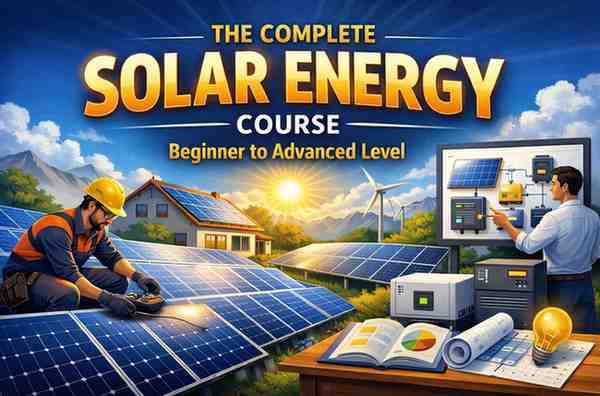
Renewable energy skills are becoming increasingly valuable as industries and governments accelerate the transition toward sustainable power solutions. The Complete SOLAR ENERGY Course: Beginner to Advanced Level is designed to provide a structured learning path into solar photovoltaic (PV) systems — covering everything from foundational theory to practical system design and real-world implementation.
This review provides a detailed, unbiased analysis of the course structure, learning outcomes, strengths, limitations, and ideal learner profile to help you decide whether this program aligns with your goals.
What You Will Learn
The course aims to build both conceptual understanding and applied technical capability. Key learning outcomes include:
-
Solar energy fundamentals and power concepts
-
How photovoltaic cells and solar modules work
-
Components of a solar PV system
-
Inverters, junction boxes, and electrical protections
-
Grid-tie solar system architecture
-
Solar array sizing and configuration
-
Peak sun hour calculations for any location
-
Roof orientation, tilt angle, and efficiency considerations
-
Energy production vs. consumption analysis
-
Component selection and system optimization
-
Practical system design workflow
Students also learn how to evaluate whether a property is suitable for solar installation and how to estimate system performance and savings.
Course Structure and Content
The training is divided into progressive modules that gradually increase in technical depth.
1. Solar Energy Fundamentals
Begins with core concepts such as energy units, irradiance, and power relationships. This section establishes the theoretical base required for PV system design.
2. Solar Cells and Modules
Explains photovoltaic effects, module types, and performance characteristics. Learners understand how electricity is generated at the material level.
3. PV System Components
Covers major hardware elements including:
-
Solar panels
-
DC/DC optimizers
-
Inverters
-
Solar meters
-
Wiring systems and electrical protections
4. System Design and Sizing
One of the most practical parts of the course, focusing on:
-
Array sizing calculations
-
Energy demand estimation
-
Peak sun hour analysis
-
Panel placement optimization
-
Efficiency loss considerations
5. Real-World Application
Students learn how system production compares with household consumption and how to evaluate economic benefits such as energy savings.
The structured progression helps learners move from theory into applied engineering thinking rather than memorization.
Teaching Style and Learning Experience
The instructor uses a practical, industry-focused teaching approach. Concepts are explained step-by-step, with emphasis on understanding system behavior rather than only formulas.
Key teaching characteristics include:
-
Concept-first explanations before calculations
-
Visual breakdown of PV system components
-
Practical examples tied to installation scenarios
-
Engineering-focused reasoning
The pacing is beginner-friendly but gradually introduces technical terminology expected in solar engineering environments.
Practical Skills You Gain
By the end of the course, students typically understand how to:
-
Design a complete grid-tie solar PV system
-
Select appropriate system components
-
Calculate solar generation potential
-
Evaluate installation feasibility
-
Interpret system performance variables
These competencies are directly applicable to entry-level roles in solar installation, system design assistance, or renewable energy consulting.
Who This Course Is Best For
This course is ideal for:
-
Beginners interested in renewable energy careers
-
Electrical or mechanical engineering students
-
Solar installation technicians
-
Energy consultants and sustainability professionals
-
Entrepreneurs exploring solar business opportunities
-
Homeowners wanting technical understanding of solar systems
Because the course starts from fundamentals, prior solar knowledge is not required.
Strengths of the Course
Comprehensive Beginner-to-Advanced Coverage
The course successfully bridges theory and practical implementation, covering both electrical fundamentals and real system design.
Industry-Relevant Skills
Topics such as array sizing, component selection, and roof analysis reflect real decision-making processes used in solar projects.
Clear Learning Progression
The structured flow helps learners build confidence gradually instead of overwhelming them with advanced calculations early.
Practical Design Orientation
Students learn how solar systems function in real environments rather than purely academic theory.
Potential Limitations
-
Primary focus is on grid-tie PV systems; off-grid systems receive less emphasis.
-
Advanced electrical simulation tools are not deeply covered.
-
Experienced electrical engineers may find early sections introductory.
These limitations are typical for courses designed to remain accessible to beginners.
Career and Skill Value
Solar energy is one of the fastest-growing technical sectors globally, creating demand for professionals who understand system design and performance evaluation. Courses like this help learners build foundational competence needed for:
-
Solar PV technician roles
-
Junior system design positions
-
Renewable energy consulting support
-
Entry into green energy entrepreneurship
The practical orientation makes it especially useful for those aiming to enter the industry rather than pursue purely academic study.
Summary
The Complete SOLAR ENERGY Course: Beginner to Advanced Level is a well-structured and practical introduction to photovoltaic system design. It balances engineering theory with applied knowledge, allowing learners to understand not just how solar systems work but how to design and evaluate them.